

Unearthing the Secrets: Shedding Light on Money Laundering Techniques in the Digital Age
.svg)
Money laundering, a practice deeply rooted in history, persists as a persistent menace to the worldwide economy. It erodes the very foundations of financial systems, empowering illicit enterprises to flourish. With the relentless march of technology, money laundering has undergone a metamorphosis, aligning itself with the digital era. As a result, there is an urgent need for advanced detection techniques and preventive measures.
This comprehensive article ventures into the labyrinthine intricacies of money laundering, illuminating its methodologies, and strategies for detection and emphasising the utmost importance of unwavering vigilance in protecting against this nefarious activity.
What is Money Laundering?
Money laundering stands as a sophisticated method employed to veil the true source of unlawfully obtained funds, camouflaging them to appear lawful. It encompasses a series of intricate manoeuvres aimed at converting ill-gotten gains, often stemming from illicit activities like drug trafficking, fraud, or corruption, into seemingly legitimate assets.
The multifaceted nature of this process unfolds in three distinct stages: placement, layering, and integration, each playing a crucial role in obfuscating the illicit origins and seamlessly integrating the funds into the legitimate financial system.

Money Laundering Techniques
Structuring
Structuring, alternatively referred to as smurfing or the practice of structuring deposits, encompasses the meticulous process of fragmenting substantial sums of illicit funds into smaller, more inconspicuous transactions. The primary objective of this technique is to cunningly sidestep financial reporting obligations and mitigate the level of scrutiny imposed by vigilant authorities. By adopting this approach, money launderers strive to remain under the radar and elude the prying eyes of regulatory entities.
Bulk Cash Smuggling
Bulk cash smuggling encompasses the illicit practice of physically conveying significant volumes of currency across borders or regions, deftly evading the watchful eyes of regulatory controls and sophisticated detection systems. In pursuit of their nefarious objectives, criminals frequently exploit susceptible transportation avenues, skillfully manoeuvring to transport their unlawfully acquired funds discreetly.
Cash-Intensive Businesses
Money launderers strategically capitalize on cash-intensive enterprises, encompassing establishments such as bustling casinos, thriving restaurants, and bustling retail stores, wherein substantial cash transactions are commonplace. With finesse, they intermingle their illicitly acquired funds with the lawful revenue generated by these businesses, cunningly shrouding the dubious origins of their monetary gains.
Investments in Commodities
By engaging in investments within the realm of commodities, encompassing valuable assets like precious metals, exquisite gemstones, or captivating artwork, money launderers skillfully exploit an avenue to imbue their ill-gotten gains with an aura of legitimacy. These alluring assets, prized for their inherent value, boast the advantage of portability, easy storage, and seamless saleability, rendering the task of tracing the funds' initial source a perplexing challenge.
Trade-Based Laundering
Trade-based laundering encompasses the deceptive manipulation of international trade transactions, artfully obfuscating the authentic value attributed to the goods or services being traded. Through crafty schemes involving misrepresenting prices, quantities, or even the commodities' quality, criminals ingeniously navigate the intricate realm of cross-border transactions. This intricate web of deceit enables them to clandestinely move funds across borders, seamlessly camouflaging the illicit origins of their monetary dealings.
Shell Companies and Trusts
Shell companies and trusts serve as instrumental tools utilised to weave an intricate tapestry of interrelated transactions, deliberately adding layers of complexity that pose significant hurdles to tracing the flow of funds. The crafty stratagem employed by money launderers involves the establishment of entities devoid of any genuine business purpose, enabling them to cloak the authentic ownership and control of their assets in a shroud of ambiguity.
Round-Tripping
Round-tripping encompasses the deceptive practice of artificially magnifying transactions, artfully crafting a mirage of bona fide economic activity. Crafty criminals deftly navigate a labyrinthine path, skillfully manoeuvring funds through a convoluted network of intermediaries or jurisdictions. In doing so, they adeptly cloak the funds' true origins and intended purpose, casting a veil of opacity over their illicit endeavours.
Bank Capture
Bank capture pertains to the malevolent infiltration of financial institutions by criminals who skillfully exploit vulnerabilities inherent within the intricate fabric of the banking system. Through cunning manipulation of internal processes or clandestine collusion with complicit bank employees, these unscrupulous actors navigate the institution's inner workings, covertly channelling illicit funds through seemingly legitimate avenues, evading detection and raising minimal suspicion.
Casinos
Money launderers frequently seize upon the abundant opportunities presented by casinos, enticed by the sheer magnitude of cash transactions and the relatively restricted regulatory oversight. Skillfully leveraging this environment, they ingeniously convert their illicit funds into casino chips, engaging in a transient period of gambling to give an illusion of legitimacy to their tainted wealth.
Subsequently, these astute criminals proceed to redeem their chips, obtaining a check in return. This clever manoeuvre effectively conceals the illicit origins of the funds and grants an appearance of lawful validation.
Other Gambling
In addition to casinos, money launderers may readily exploit an array of alternative gambling avenues, spanning from online gambling platforms and sports betting to the realm of lottery systems. Within these diverse domains, characterized by substantial cash flow and an inherent cloak of anonymity, money launderers find alluring opportunities to cleanse their illicit funds. The enticing amalgamation of considerable monetary transactions and the veiled nature of gambling activities renders it an enticing choice for those seeking to obscure the origins of their ill-gotten gains.
Black Salaries
Black salaries denote the illicit practice of remunerating employees through covert means, operating outside the boundaries of official documentation and legitimate record-keeping. This clandestine technique provides a cloak for criminals, enabling them to seamlessly blend their ill-gotten funds into the fabric of the lawful economy, masquerading as bona fide salary disbursements.
Tax Amnesties
Money launderers, on occasion, capitalize on the availability of tax amnesty programs or voluntary disclosure initiatives extended by governmental bodies. By subjecting previously undisclosed funds to tax payment, these unscrupulous individuals can manipulate the system to bestow a cloak of legitimacy upon their ill-gotten riches, effectively sidestepping intensified scrutiny.
Business Email Compromise
In this era of rapid digital advancements, criminals have honed their skills in the realm of money laundering, employing intricate methodologies such as the notorious business email compromise (BEC). This sophisticated technique entails assuming the identity of a genuine business entity through deceptive email communications, cunningly manipulating unsuspecting individuals into unknowingly transferring funds to fraudulent accounts, thereby facilitating the illicit flow of money.
Transaction Laundering
Transaction laundering revolves around the devious art of camouflaging illicit transactions within the guise of a lawful stream of payments. Crafty money launderers skillfully exploit legitimate platforms or businesses as conduits to process their nefarious transactions, effectively concealing the underlying illegal activity and rendering detection a formidable challenge.
Cyber-laundering
In the wake of the burgeoning prominence of cryptocurrencies and the emergence of online financial systems, money laundering has expanded its horizons through the realm of cyber-laundering. Astute criminals harness the power of digital currencies, leverage anonymous online transactions, and navigate intricate webs of financial networks, deftly obscuring the true origins and destinations of their illicit funds.
Money Laundering in the Digital Age
The digital age has presented both challenges and opportunities in the realm of money laundering. The rapid advancement of technology has facilitated the movement of funds across borders, increased anonymity, and provided innovative means for concealing illegal activities. Virtual currencies, online payment systems, and decentralised platforms have become attractive tools for money launderers.
Financial institutions and law enforcement agencies must adapt their detection methods and employ advanced technologies to track illicit transactions in the digital landscape to combat this evolving threat.
Detecting Digital Money Laundering
In order to proficiently identify instances of digital money laundering, institutions must harness the power of cutting-edge analytics, machine learning, and artificial intelligence algorithms. These innovative technologies possess the capability to scrutinize vast quantities of data, unveil intricate patterns, and expose irregularities that serve as red flags for money laundering activities.
Establishing and implementing robust Know Your Customer (KYC) procedures, fortified transaction monitoring systems, and fostering collaborative data-sharing initiatives between institutions and regulatory bodies emerge as pivotal measures in the relentless fight against digital money laundering.
Ways to Prevent Money Laundering
The prevention of money laundering necessitates adopting a comprehensive approach encompassing robust regulatory frameworks, stringent enforcement mechanisms, and proactive measures undertaken by financial institutions. Deploying a wide array of effective strategies, some notable approaches include:
- Enhanced Due Diligence: Instituting comprehensive measures for customer due diligence, encompassing meticulous verification of customer identities, diligent assessment of their risk profiles, and continuous monitoring of transactions to identify any signs of suspicious activity.
- Regulatory Compliance: Ensuring unwavering adherence to anti-money laundering (AML) and counter-terrorism financing (CTF) regulations prescribed by regulatory authorities while perpetually updating internal policies and procedures to stay abreast of ever-evolving threats.
- Training and Awareness: Regularly equipping employees with tailored training sessions to hone their ability to identify telltale indicators, comprehend intricate money laundering techniques, and diligently report any suspicious activities to the appropriate authorities.
- Collaboration and Information Sharing: Actively fostering a culture of collaboration among financial institutions, law enforcement agencies, and regulatory bodies, promoting the seamless exchange of valuable intelligence and reinforcing collective efforts to combat the insidious practice of money laundering.
- Technological Solutions: Making strategic investments in state-of-the-art technological solutions, harnessing the power of cutting-edge systems powered by artificial intelligence, blockchain analytics, and advanced transaction monitoring tools. This proactive approach enhances detection capabilities, elevates risk assessment processes, and fortifies the collective arsenal against the pervasive threat of money laundering.
{{cta-guide}}
Final Thoughts
Money laundering continues to pose a formidable challenge to the global financial system, exerting profound threats upon the integrity and stability of economies spanning the globe. Recognizing and comprehending the diverse array of techniques employed by money launderers, particularly in the era of digital advancements, assumes paramount importance in formulating robust strategies for detection and prevention. Embracing cutting-edge technologies, fostering collaborative endeavours, and implementing stringent compliance measures serve as the pillars upon which we can bolster our ability to identify and deter money laundering activities effectively.
In this age of unparalleled digital transformation, maintaining unwavering vigilance and agile adaptability to the ever-evolving landscape of money laundering emerge as indispensable imperatives. By steadfastly embracing a proactive stance and incessantly refining our detection methodologies, we fortify the bulwarks that safeguard our financial systems, shield legitimate enterprises, and contribute resolutely to the global crusade against illicit activities.
Let us always bear in mind that the battle against money laundering demands an unwavering collective effort. Financial institutions, regulatory bodies, law enforcement agencies, and individuals must join forces, hand in hand, in the tireless pursuit of exposing the shadows, unearthing illicit funds, and forging a financial environment that radiates transparency and security for the welfare of all.
FAQs (Frequently Asked Questions)
Q: What is the primary goal of money laundering?
A: The primary goal of money laundering is to make illegally obtained funds appear legitimate by disguising their true origins and integrating them into the legal economy.
Q: How does money laundering in the digital age differ from traditional methods?
A: Money laundering in the digital age takes advantage of technological advancements, such as cryptocurrencies and online platforms, to facilitate illicit transactions. It allows criminals to exploit the speed, anonymity, and global reach of digital financial systems.
Q: How do criminals use shell companies and trusts for money laundering?
A: Criminals establish shell companies and trusts to create a complex web of transactions, making it difficult to trace the flow of funds. These entities provide a façade of legitimacy, allowing money launderers to obscure the true ownership and control of their assets.
Q: What are some effective methods for detecting digital money laundering?
A: Detecting digital money laundering involves leveraging advanced technologies like artificial intelligence and machine learning algorithms. Apart from analysing sizable amounts of data, these technologies can identify patterns and detect anomalies that can indicate money laundering activities.
Q: How can financial institutions prevent money laundering?
A: Financial institutions can prevent money laundering by implementing enhanced due diligence measures, complying with regulatory frameworks, providing comprehensive employee training, promoting collaboration and information sharing, and investing in advanced technological solutions for transaction monitoring and risk assessment.
Q: What role do regulatory bodies and law enforcement agencies play in combating money laundering?
A: Regulatory bodies and law enforcement agencies play a crucial role in setting and enforcing anti-money laundering regulations, conducting investigations, sharing intelligence, and collaborating with financial institutions to detect and prevent money laundering activities.
Q: Why is it important for individuals to report suspicious activities related to money laundering?
A: Individuals play a vital role in the fight against money laundering by being vigilant and reporting any suspicious activities they come across. Reporting such activities can help authorities uncover illicit transactions, disrupt criminal networks, and safeguard the integrity of the financial system.
Q: How can technology contribute to the prevention of money laundering?
A: Technology can contribute to the prevention of money laundering by providing advanced analytics, transaction monitoring tools, and blockchain analytics. These technologies enhance detection capabilities, improve risk assessment processes, and enable more effective identification of suspicious transactions.
Q: What are the potential consequences of failing to prevent money laundering?
A: Failing to prevent money laundering can have severe consequences, including reputational damage, financial losses, legal repercussions, regulatory sanctions, and the facilitation of criminal activities such as drug trafficking, terrorism financing, and corruption.
Q: Why is collaboration between different stakeholders crucial in combating money laundering?
A: Collaboration between financial institutions, regulatory bodies, law enforcement agencies, and individuals is crucial in combating money laundering. It facilitates the sharing of information, intelligence, and best practices, strengthens detection capabilities, and enhances the overall effectiveness of anti-money laundering efforts.
Experience the most intelligent AML and fraud prevention platform
Experience the most intelligent AML and fraud prevention platform
Experience the most intelligent AML and fraud prevention platform
Top AML Scenarios in ASEAN
The Role of AML Software in Compliance
The Role of AML Software in Compliance
Talk to an Expert
Ready to Streamline Your Anti-Financial Crime Compliance?
Our Thought Leadership Guides
The Fake Trading Empire: Inside Taiwan’s Multi-Million Dollar Investment Scam Machine
In April 2026, Taiwanese authorities dismantled what investigators allege was a highly organised investment fraud operation built to imitate the mechanics of a legitimate trading business.
Victims were reportedly shown convincing trading dashboards, fabricated profits, and professional-looking investment interfaces designed to create the illusion of real market activity. Behind the scenes, investigators believe the operation functioned less like a traditional scam and more like a structured financial enterprise — complete with coordinated recruitment, layered fund movement, mule-account networks, and laundering infrastructure built to move illicit proceeds before detection.
This is what makes the Taiwan case important.
It is not simply another online investment scam. It is a reminder that modern fraud networks are increasingly evolving into industrialised financial ecosystems designed to manufacture trust at scale.
For banks, fintechs, and compliance teams, that changes the challenge entirely.

Inside the Alleged Investment Fraud Operation
According to Taiwanese investigators, the syndicate allegedly used fake investment platforms and fraudulent financial products to convince victims to transfer funds into accounts controlled by the network.
Victims reportedly believed they were participating in legitimate investment opportunities involving high returns and active trading activity. Some were allegedly shown manipulated dashboards and fabricated profit figures designed to create the appearance of successful investments.
That detail is important.
Modern investment scams no longer rely solely on persuasive phone calls or suspicious-looking websites.
Today’s fraud operations increasingly replicate the appearance of legitimate financial services:
- professional interfaces,
- simulated trading activity,
- customer support channels,
- fake account managers,
- and convincing financial narratives.
The result is a scam environment that feels operationally real to victims.
And that realism significantly increases fraud conversion rates.
The Rise of Investment Scams Designed to Mimic Real Financial Platforms
What makes cases like this especially concerning is how closely they now resemble legitimate financial ecosystems.
Fraudsters are no longer simply asking victims to transfer money into unknown accounts.
Instead, they are building:
- fake investment platforms,
- structured onboarding journeys,
- simulated portfolio growth,
- staged withdrawal processes,
- and layered communication strategies.
In many cases, victims may interact with the platform for weeks or months before realising the funds are inaccessible.
This reflects a broader shift in financial crime:
from opportunistic scams → to investment scams engineered to resemble legitimate financial ecosystems.
The objective is not just theft.
It is trust creation.
And once trust is established, victims often continue transferring increasingly larger amounts of money into the system.
Why This Case Matters for Financial Institutions
For compliance teams, the Taiwan investment scam investigation highlights a difficult operational reality.
The financial footprint of investment fraud rarely looks obviously criminal in isolation.
A victim transfer may appear legitimate.
A beneficiary account may initially appear low-risk.
Payment values may remain below traditional thresholds.
But behind those individual transactions often sits a coordinated laundering structure designed to rapidly disperse funds before intervention occurs.
That is where the real challenge begins.
Fraud proceeds are rarely left sitting in a single account.
Instead, they are often:
- fragmented,
- layered,
- redistributed,
- converted across payment channels,
- and moved through multiple intermediary accounts.
By the time institutions identify suspicious activity, the funds may already have travelled across several entities, platforms, or jurisdictions.
The Critical Role of Mule Networks
No large-scale investment scam operates efficiently without money mule infrastructure.
The Taiwan case reinforces how essential mule accounts remain to modern fraud ecosystems.
Once victims transfer funds, the criminal network still faces a major operational challenge:
moving and disguising the proceeds without triggering financial controls.
This is where mule accounts become critical.
These accounts may be:
- recruited through job scams,
- rented through online channels,
- purchased from vulnerable individuals,
- or created using synthetic identities.
Their role is simple:
receive funds, move them quickly, and create distance between victims and the organisers.
For financial institutions, this creates a layered detection problem.
Individual mule transactions may appear relatively small or routine.
But collectively, they can form sophisticated laundering networks capable of moving large volumes of illicit value rapidly across the financial system.

Why Investment Scams Are Becoming Harder to Detect
Historically, many scams relied on urgency and obvious manipulation.
Modern investment fraud is evolving differently.
The Taiwan case highlights several trends making detection increasingly difficult:
1. Longer victim engagement cycles
Fraudsters spend more time building credibility before extracting significant funds.
2. Professional-looking financial interfaces
Fake platforms increasingly resemble legitimate brokerages and fintech applications.
3. Behavioural manipulation over technical compromise
Victims often authorise the transfers themselves, reducing traditional fraud triggers.
4. Distributed fund movement
Instead of large transfers into single accounts, funds may be fragmented across multiple beneficiaries and payment rails.
This combination makes investment scams operationally complex from both a fraud and AML perspective.
The Convergence of Fraud and Money Laundering
One of the biggest mistakes institutions still make is treating fraud and AML as separate problems.
Cases like this show why that distinction no longer reflects reality.
The scam itself is only phase one.
Phase two involves:
- receiving the proceeds,
- layering transactions,
- obscuring ownership,
- and integrating funds into the financial system.
That is fundamentally an AML problem.
In practice, the same criminal network may simultaneously engage in:
- fraud,
- mule recruitment,
- account abuse,
- shell company usage,
- and cross-border fund movement.
This convergence is becoming increasingly common across Asia-Pacific financial crime investigations.
The Hidden Operational Challenge for Banks
What makes these cases particularly difficult for banks is that many customer interactions appear legitimate on the surface.
Victims willingly initiate payments.
Beneficiary accounts may initially show limited risk history.
Transactions may not breach static thresholds.
Traditional rules-based systems often struggle in these environments because the suspicious behaviour only becomes visible when viewed collectively.
For example:
- repeated transfers to newly created beneficiaries,
- clusters of accounts sharing behavioural similarities,
- rapid fund movement after receipt,
- unusual device or IP overlaps,
- and patterns linking accounts across institutions.
These signals are rarely definitive individually.
Together, they form a network.
And increasingly, financial crime detection is becoming a network visibility problem.
Why Static Detection Models Are Falling Behind
Modern fraud networks evolve rapidly.
Static controls often do not.
Investment scam syndicates continuously adapt:
- onboarding tactics,
- payment methods,
- platform design,
- communication styles,
- and laundering behaviour.
This creates operational pressure on compliance teams still relying heavily on:
- static thresholds,
- isolated transaction monitoring,
- manual reviews,
- and fragmented fraud systems.
The problem is not necessarily that institutions lack data.
The problem is that risk signals often remain disconnected.
Understanding how accounts, payments, devices, entities, and behaviours relate to each other is becoming increasingly important in detecting organised financial crime.
Lessons Financial Institutions Should Take from This Case
The Taiwan investment fraud investigation highlights several important lessons for financial institutions.
Fraud is becoming operationally sophisticated
Scam operations increasingly resemble structured financial businesses rather than opportunistic crime.
Payment monitoring alone is not enough
Institutions need visibility into behavioural and network relationships, not just transaction anomalies.
Fraud and AML convergence is accelerating
The same infrastructure enabling scams is often used to move and disguise illicit proceeds.
Mule detection is becoming strategically critical
Mule accounts remain one of the most important operational enablers of organised fraud.
Cross-channel intelligence matters
Risk signals increasingly emerge across onboarding, transactions, devices, counterparties, and behavioural patterns simultaneously.
How Technology Can Help Detect Organised Fraud Ecosystems
Cases like this reinforce why financial institutions are moving toward more intelligence-driven detection approaches.
Traditional rule-based systems remain important, but increasingly they need to be supported by:
- behavioural analytics,
- network intelligence,
- typology-driven detection,
- and cross-functional fraud-AML visibility.
This is especially important in investment scam scenarios because suspicious behaviour rarely appears through a single transaction or isolated alert.
Instead, risk emerges gradually through connected patterns across customers, beneficiaries, accounts, and fund flows.
Platforms such as Tookitaki’s FinCense are designed to help institutions detect these hidden relationships earlier by combining:
- AML and fraud convergence,
- behavioural monitoring,
- network-based intelligence,
- and collaborative typology insights through the AFC Ecosystem.
In scam-driven laundering cases, this allows institutions to move beyond isolated detection and toward identifying broader financial crime ecosystems before they scale further.
The Bigger Picture: Investment Fraud as Organised Financial Crime
The Taiwan case reflects a broader global trend.
Investment scams are no longer isolated cyber incidents run by small groups.
They are increasingly:
- organised,
- scalable,
- cross-border,
- financially sophisticated,
- and deeply connected to laundering infrastructure.
That evolution matters because it changes how institutions must think about financial crime risk.
The challenge is no longer simply stopping fraudulent transactions.
It is understanding how organised criminal systems operate across:
- digital platforms,
- payment rails,
- onboarding systems,
- mule networks,
- and financial ecosystems simultaneously.
Final Thoughts
The alleged investment fraud syndicate uncovered in Taiwan offers another reminder that financial crime is becoming more industrialised, more technologically enabled, and more operationally sophisticated.
What appears outwardly as a simple investment scam may actually involve:
- organised laundering infrastructure,
- coordinated mule activity,
- behavioural manipulation,
- and complex financial movement across multiple channels.
For financial institutions, this creates a difficult but important challenge.
The future of financial crime detection will depend less on identifying isolated suspicious transactions and more on recognising hidden relationships, behavioural coordination, and evolving criminal typologies before they scale into systemic exposure.
The next generation of financial crime will not always look suspicious on the surface. Increasingly, it will look like a legitimate financial business operating in plain sight.

Sanctions Screening in the Philippines: BSP and AMLC Requirements
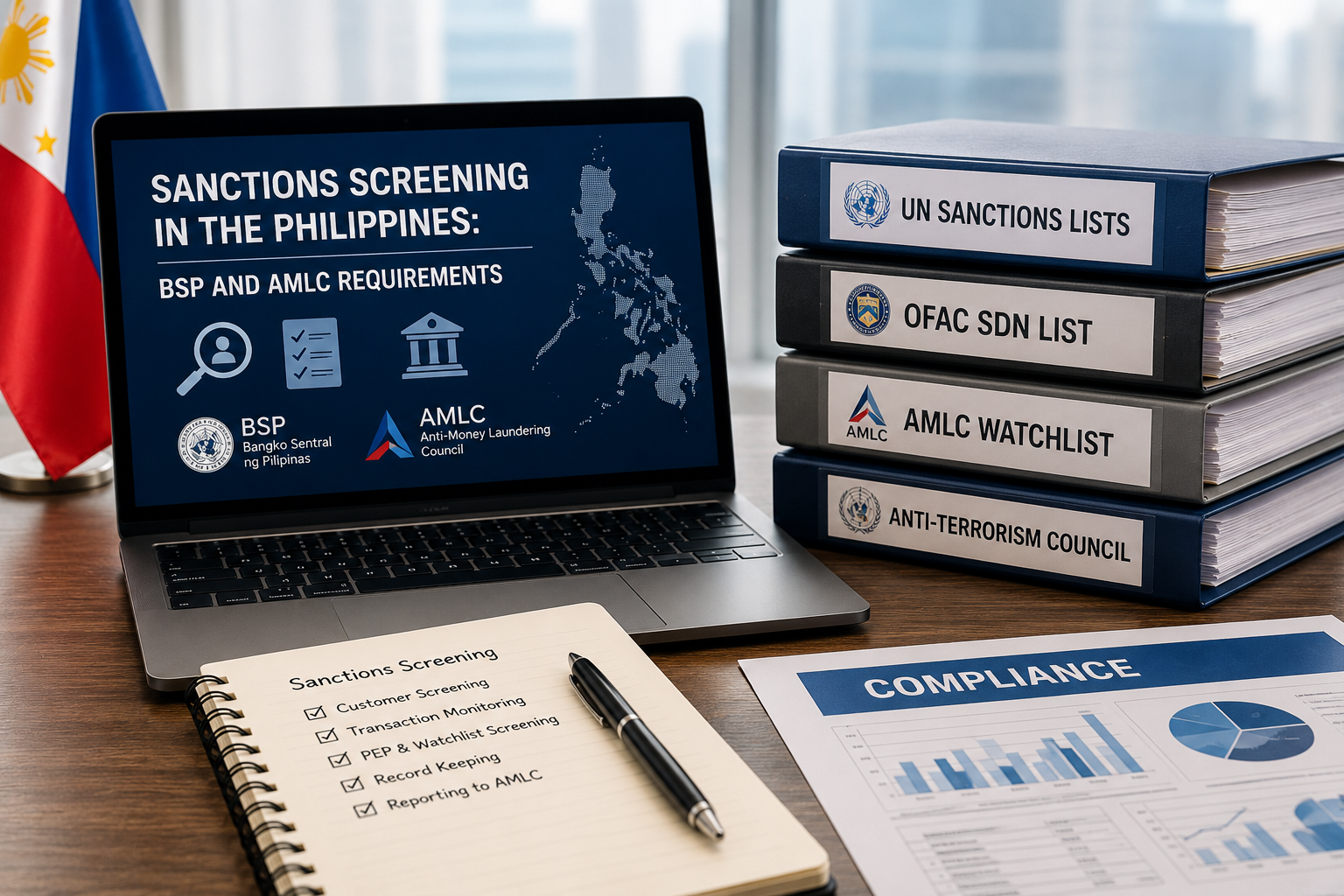
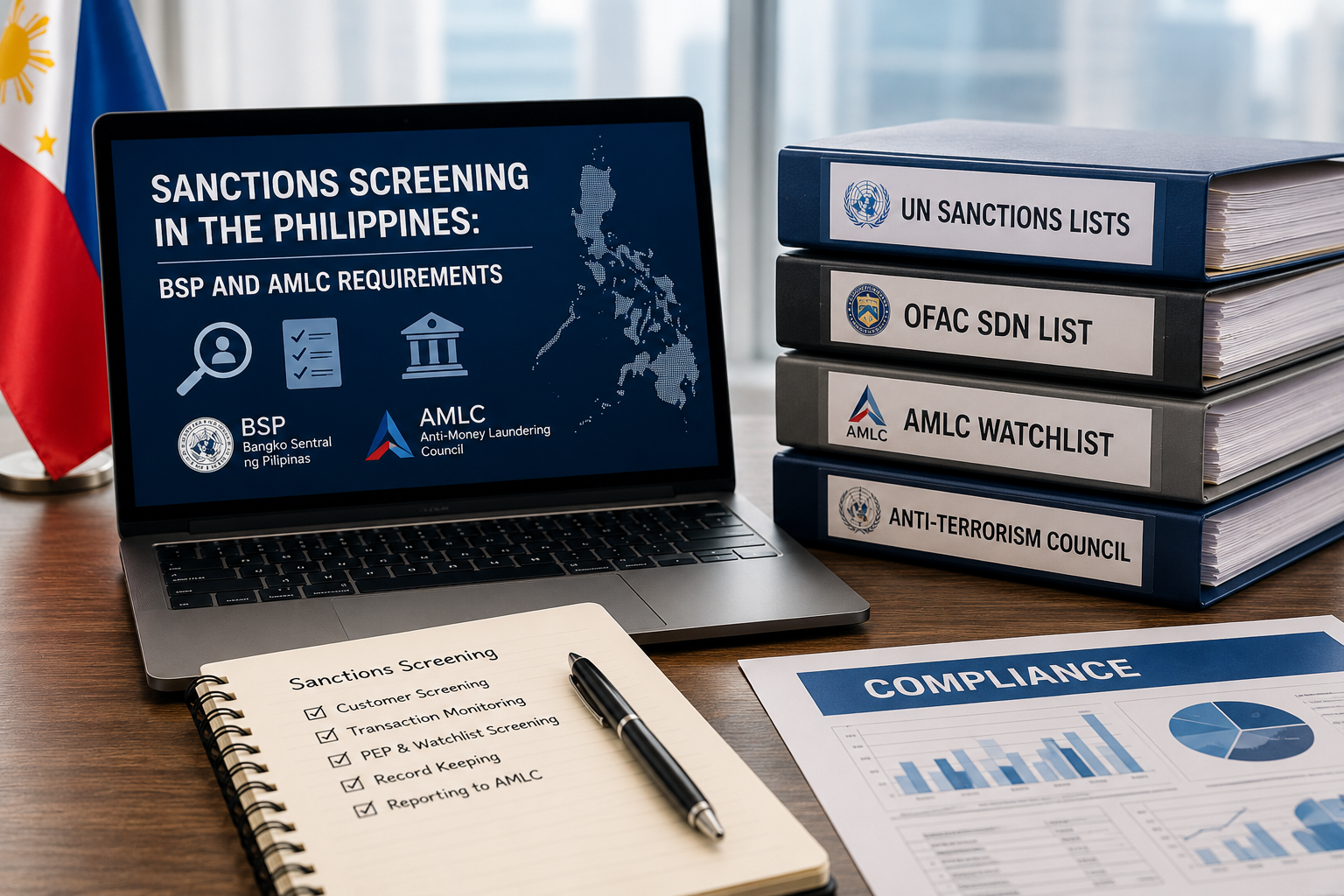
The Philippines operates one of the more layered sanctions frameworks in Southeast Asia. Obligations come from three directions simultaneously: international designations through the UN Security Council, domestic terrorism designations through the Anti-Terrorism Council, and oversight of the entire framework by the Anti-Money Laundering Council.
The stakes became concrete between 2021 and 2023. The Philippines sat on the FATF grey list for two years, subject to heightened monitoring and increased scrutiny from correspondent banks and international counterparties. Exiting the grey list — which the Philippines achieved in January 2023 — required demonstrating measurable improvements in sanctions enforcement, among other areas of AML/CFT reform.
That exit does not reduce compliance pressure. In many respects, it increases it. BSP-supervised institutions that allowed monitoring gaps to persist during the grey-list period now face examiners who know exactly what to look for — and who are checking whether post-2023 improvements are real or cosmetic.
The Philippine Sanctions Framework: Who Issues the Lists
Before a financial institution can build a screening programme, it needs to understand what it is screening against. In the Philippines, that means four distinct sources of designation.
UN Security Council Lists
Philippine law requires immediate asset freezes of persons and entities designated under UNSC resolutions. The key designations are:
- UNSCR 1267/1989: Al-Qaeda and associated individuals and entities
- UNSCR 1988: Taliban
- UNSCR 1718: North Korea — persons and entities associated with DPRK's weapons of mass destruction and ballistic missile programmes
These lists are maintained on the UN's consolidated sanctions list, which is updated without a fixed schedule. Designations can be added multiple times in a single week. The legal freeze obligation under Philippine law attaches immediately upon UNSC designation — there is no grace period between the designation appearing on the list and the institution's obligation to act.
AMLC — The Philippines' Financial Intelligence Unit
The Anti-Money Laundering Council is the Philippines' primary FIU and the central authority for AML/CFT supervision. AMLC maintains its own domestic watchlist and can apply to the Court of Appeals for freeze orders against individuals and entities not listed by the UNSC but suspected of money laundering or terrorism financing under Philippine law.
For BSP-supervised institutions, AMLC is both a regulator and a reporting recipient. Sanctions matches must be reported to AMLC. STR and CTR obligations flow through AMLC's systems. When BSP or AMLC conducts an examination and finds screening deficiencies, AMLC is the body that determines the regulatory response.
OFAC — Not a Legal Obligation, But a Practical Necessity
The US Treasury's Office of Foreign Assets Control SDN (Specially Designated Nationals) list is not a direct legal obligation for Philippine-incorporated entities. It becomes unavoidable through correspondent banking. Any Philippine financial institution that processes USD transactions or maintains US correspondent banking relationships must screen against the OFAC SDN list or risk losing those relationships. For Philippine banks, money service businesses, and remittance companies with any USD exposure — which covers the vast majority — OFAC screening is a business-critical function regardless of its legal status.
Domestic Terrorism Designations Under the Anti-Terrorism Act 2020
Republic Act 11479, the Anti-Terrorism Act 2020, gives the Anti-Terrorism Council (ATC) authority to designate individuals and groups as terrorists. This is a domestic designation mechanism that operates independently of UNSC processes.
The freeze obligation for ATC-designated persons and entities is the same as for UNSC designations: 24 hours. Upon an ATC designation being published, a BSP-supervised institution must freeze the assets of that person or entity within 24 hours and report the freeze to AMLC. There is no provision for a staged or delayed response.
The BSP Regulatory Framework for Sanctions Screening
BSP-supervised institutions — banks, quasi-banks, money service businesses, e-money issuers, and virtual asset service providers — are governed by a framework built across several circulars.
BSP Circular 706 (2011) is the foundational AML circular. It established the AML programme requirements that all BSP-supervised institutions must meet, including customer identification, transaction monitoring, record-keeping, and screening obligations. Subsequent circulars have amended and extended these requirements.
BSP Circular 950 (2017) tightened CDD and screening requirements in the context of financial inclusion products, specifically basic deposit accounts. Even simplified or low-feature accounts are subject to screening obligations under this circular.
BSP Circular 1022 (2018) introduced an explicit requirement for real-time sanctions screening of wire transfers. This is not a requirement for batch screening to be completed within a reasonable timeframe — it is a requirement for screening at the point of wire transfer instruction, before the transaction is processed.
The core BSP screening requirement covers:
- All customers at onboarding
- Beneficial owners of corporate accounts
- Counterparties in wire transfers and other transactions
- Ongoing re-screening when applicable sanctions lists are updated
This last point is where many institutions fall short. Screening at onboarding is not sufficient. The obligation is continuous. When a new designation is added to the UNSC consolidated list or the AMLC domestic list, existing customers and counterparties must be re-screened against the updated list.
AMLC Reporting Requirements When a Match Occurs
When a sanctions match is confirmed, three reporting obligations are triggered under Philippine law.
Covered Transaction Reports (CTRs): Any transaction involving a designated person or entity must be reported to AMLC as a CTR, regardless of the transaction amount. There is no minimum threshold. A PHP 500 cash deposit from a designated individual is a reportable covered transaction.
Freeze reporting: When assets are frozen following a sanctions match, the institution must notify AMLC within 24 hours of the freeze action. This is a separate obligation from the CTR — both must be filed.
Suspicious Transaction Reports (STRs): STRs cover the broader category of suspicious activity, including transactions that do not involve a confirmed designated person but where the institution has grounds to suspect money laundering or terrorism financing. The STR filing deadline is 5 business days from the date of determination — meaning the date on which the compliance team concluded the activity was suspicious, not the date of the underlying transaction. This distinction matters when BSP or AMLC reviews filing timelines.
All screening records, alert decisions, and freeze reports must be retained for a minimum of 5 years. When AMLC or BSP conducts an examination, they will request documentation of screening activity — not just whether screens were run, but when they were run, against which list versions, what matches appeared, and what decision was made on each match.
What Effective Sanctions Screening Requires in Practice
Compliance with BSP screening obligations requires more than purchasing a watchlist database. The following requirements shape what a compliant programme must deliver.
List Coverage
The minimum legal requirement is the UNSC consolidated list plus the AMLC domestic watchlist. A compliant programme that screens only against these two sources will still miss OFAC designations that are operationally necessary for any institution with USD exposure. Best practice adds the OFAC SDN list, the EU Consolidated List, and ATC domestic designations — and maintains the update cadence for each.
Screening Frequency
Customer records must be re-screened every time a sanctions list is updated. The UNSC consolidated list can be updated multiple times in a single week. A batch re-screening process that runs overnight or over 24-48 hours will miss the window on new designations. For UNSC and ATC designations, the freeze obligation is 24 hours from the designation — not 24 hours from the institution's next scheduled screening run.
Fuzzy Name Matching and Alias Coverage
Sanctions designations frequently involve names transliterated from Arabic, Russian, Korean, or Chinese into Roman script. A system that does only exact string matching will miss clear matches. The practical standard is phonetic and fuzzy matching with configurable similarity thresholds, so that variations in transliteration are caught by the algorithm rather than escaping through string-exact gaps.
Each designated person or entity may carry dozens of aliases in the list data. An institution that screens only against primary names and ignores AKA entries is screening against an incomplete version of the list. Alias coverage must be built into the matching logic, not treated as optional.
Beneficial Ownership Screening
BSP requires screening of beneficial owners for corporate accounts — not just the entity name at the surface level. A company may not appear on any sanctions list, but if the individual who ultimately owns or controls that company is a designated person, the account presents the same sanctions risk. Screening the entity name without screening the beneficial owner fails to meet BSP requirements and fails to detect the actual risk. For KYC processes and beneficial ownership verification, the data collected at onboarding needs to feed directly into the screening workflow.
False Positive Management
Name similarity matching in Southeast Asian contexts generates significant false positive volumes. Common names — variations of "Mohamed," "Ahmad," "Lim," "Santos" — will match against designated individuals even when the account holder has no connection to the designation. A retail banking customer whose name generates a match is almost certainly not the designated person, but the institution still needs a documented process for reaching and recording that conclusion.
A compliant programme needs disambiguation tools: date of birth matching, nationality, address, and other identifiers that allow analysts to clear false positives with documented rationale. Without this, the volume of alerts from a large customer base becomes unmanageable, and the resolution of legitimate matches gets buried.
Common Compliance Gaps in Philippine Sanctions Screening
BSP and AMLC examinations of sanctions screening programmes repeatedly find the same categories of deficiency.
Screening only at onboarding. Customer records are screened when the account is opened and not again. List updates are not triggering re-screening of the existing base. A customer who was clean at onboarding may have been designated three months later, and the institution has no process to detect this.
Single-list screening. Many institutions screen against the UNSC consolidated list and nothing else. AMLC domestic designations are missed. ATC designations are missed. OFAC SDN entries that are relevant to the institution's USD transactions are missed entirely.
No alias coverage. The screening system matches against primary names only. An Al-Qaeda-affiliated entity listed under an abbreviation or a known alias does not trigger an alert because the system only checked the primary designation entry.
Manual re-screening. Compliance teams run manual re-screening processes when list updates arrive, relying on staff to download updated lists, upload them to a matching tool, run the comparison, and review results. At any meaningful customer volume, this process cannot keep pace with the frequency of UNSC and AMLC list updates.
No audit trail. When examiners arrive, the institution cannot produce documentation showing when each customer was screened, against which list version, what matches were generated, and how each match was resolved. BSP and AMLC expect to see this trail. An institution that can confirm its processes are compliant but cannot document them is in the same examination position as one that has no process at all.
How Technology Addresses the Screening Challenge
The compliance gaps above are, in most cases, operational gaps — the result of processes that cannot scale or that depend on manual steps that introduce delay and inconsistency.
Automated sanctions screening addresses the core operational constraints directly.
Automated list update ingestion means the screening system pulls updated lists as they are published — UNSC, AMLC, OFAC, ATC — without requiring a compliance team member to manually download and upload files. The update cycle matches the publication cycle of the list issuer, not the availability of the compliance team.
Fuzzy and phonetic matching with configurable thresholds means the compliance team sets the sensitivity. Higher sensitivity catches more potential matches at the cost of higher false positive volume; lower sensitivity reduces noise but requires careful calibration to ensure real matches are not suppressed. Both ends of this calibration should be documented and defensible to an examiner.
Alias and AKA screening is built into the match logic rather than being a secondary check. Every screening event covers the full designation entry, including all aliases, for every list in scope.
Beneficial owner screening runs as part of the corporate account onboarding workflow. When a company is onboarded and its beneficial owners are identified, those owners are screened at the same time and on the same re-screening schedule as the entity itself.
Audit trail documentation captures every screening event with timestamp, list version used, match score, analyst decision, and documented rationale for the decision. This output is the record that examiners request. For transaction monitoring programmes that need to meet this same documentation standard, the record-keeping requirements are parallel — screening logs and TM investigation records together constitute the compliance evidence trail.
When a sanctions match is confirmed in a wire transfer, the screening system can trigger both the freeze action and a transaction monitoring alert simultaneously, rather than requiring two separate manual escalation paths.
FinCense for Philippine Sanctions Screening
Sanctions screening in isolation from the broader AML programme creates its own operational problem — a match that triggers a freeze also needs to generate a CTR filing, which needs to be linked to the customer's transaction monitoring record, which may also be generating STR activity. Managing these as separate workflows produces documentation fragmentation and examination risk.
FinCense covers sanctions screening as part of an integrated AML and fraud platform. It is not a standalone screening tool connected to a separate transaction monitoring system via manual hand-offs.
For Philippine institutions, FinCense is pre-configured with the relevant list sources: UNSC consolidated list, AMLC domestic designations, OFAC SDN, and ATC designations. Screening events are logged in a format suitable for BSP and AMLC examination review.
If you are building or reviewing your sanctions screening programme against BSP requirements, the Transaction Monitoring Software Buyer's Guide provides a structured evaluation framework — covering list coverage, matching quality, audit trail requirements, and integration with TM workflows.
Book a demo to see FinCense running against Philippine sanctions scenarios — including UNSC designation matching, AMLC domestic list screening, and beneficial owner checks for corporate accounts under BSP Circular 706 requirements.
The Accountant, the Fraud Ring, and the AUD 3 Billion Question Facing Australian Banks
In late April 2026, Australian authorities arrested a Melbourne accountant allegedly linked to a sprawling money laundering and mortgage fraud syndicate connected to illicit tobacco, drug importation networks, and scam operations targeting Australian victims. The case quickly drew attention not only because of the arrest itself, but because of what sat behind it: shell companies, AI-generated documentation, questionable mortgage applications, introducer networks, and an estimated AUD 3 billion in suspect loans under scrutiny across the banking system.
For compliance teams, this is not just another fraud story.
It is a glimpse into how organised financial crime is evolving inside legitimate financial infrastructure.
The striking part is not that fraud occurred. Banks deal with fraud every day. What makes this case different is the apparent convergence of multiple risk layers: professional facilitators, synthetic documentation, organised criminal networks, and the use of legitimate financial products to absorb and move illicit value at scale.
And increasingly, these schemes no longer look obviously criminal at first glance.
From Street Crime to Structured Financial Engineering
According to reporting linked to the investigation, authorities allege the syndicate used accountants, brokers, shell entities, and false financial documentation to obtain loans from major Australian banks. Some reports also referenced the use of AI-generated documentation to support fraudulent applications.
That detail matters.
Financial crime has historically relied on concealment. Today, many criminal operations are moving toward something more sophisticated: financial engineering.
The objective is no longer simply to hide illicit funds. It is to integrate them into legitimate financial systems through structures that appear commercially plausible.
Mortgage lending becomes an entry point.
Professional services become enablers.
Corporate structures become camouflage.
The result is a fraud ecosystem that can look remarkably normal until investigators connect the dots.
Why This Case Should Concern Compliance Teams
On the surface, this appears to be a mortgage fraud and money laundering investigation.
But underneath sits a much broader operational challenge for banks and fintechs.
The alleged scheme touches several areas simultaneously:
- Fraudulent onboarding
- Synthetic or manipulated financial documentation
- Shell company misuse
- Introducer and intermediary risk
- Proceeds laundering
- Organised criminal coordination
This is precisely where many traditional detection frameworks begin to struggle.
Because each individual activity may not independently appear suspicious enough to trigger escalation.
A shell company alone is not unusual.
An accountant referral is not inherently risky.
A mortgage application with inflated income may look like isolated fraud.
But together, these elements create a networked typology.
That network effect is what modern financial crime increasingly relies upon.
The Growing Role of Professional Facilitators
One of the most uncomfortable realities emerging globally is the role of professional facilitators in enabling financial crime.
Not necessarily career criminals.
Not necessarily front-line fraudsters.
But individuals operating within legitimate professions who allegedly help structure, legitimise, or move illicit value.
The Melbourne accountant case reflects a broader pattern regulators globally have been warning about:
- Accountants
- Lawyers
- Company formation agents
- Mortgage intermediaries
- Real estate facilitators
These actors sit close to financial systems and often possess the expertise needed to create legitimacy around suspicious activity.
For financial institutions, this creates a difficult challenge.
Professional status can unintentionally reduce scrutiny.
And that makes risk harder to identify early.
The AI Layer Changes the Game
Perhaps the most important dimension of this case is the alleged use of AI-generated documentation.
That should concern every compliance and fraud leader.
Historically, document fraud carried operational friction.
Creating convincing falsified records required time, skill, and manual effort.
AI dramatically lowers that barrier.
Income statements, payslips, identity documents, corporate records, and supporting financial evidence can now be manipulated faster, cheaper, and at greater scale than before.
More importantly, AI-generated fraud often looks cleaner than traditional forgery.
That creates two immediate risks:
1. Verification systems become easier to bypass
Static document checks or basic OCR validation may no longer be sufficient.
2. Fraud investigations become slower and more complex
Investigators now face increasingly sophisticated synthetic evidence that appears internally consistent.
The compliance industry is entering a phase where fraud is no longer just digital. It is becoming algorithmically enhanced.
Why Mortgage Fraud Is Becoming an AML Problem
Mortgage fraud has traditionally been treated primarily as a credit risk issue.
That approach is becoming outdated.
Cases like this demonstrate why mortgage fraud increasingly overlaps with AML and organised crime risk.
Authorities allege the syndicate was linked not only to loan fraud, but also to illicit tobacco networks, drug importation activity, and scam proceeds.
That changes the lens entirely.
Fraudulent loans are not merely bad lending decisions. They can become mechanisms for:
- Laundering criminal proceeds
- Converting illicit funds into property assets
- Creating financial legitimacy
- Recycling criminal capital into the economy
In other words, lending channels themselves can become laundering infrastructure.
And this is not unique to Australia.
Globally, regulators are increasingly concerned about the intersection between:
- Property markets
- Organised crime
- Shell companies
- Professional facilitators
- Financial fraud
The Hidden Weakness: Fragmented Detection
One of the reasons schemes like this persist is that institutions often detect risks in silos.
Fraud teams monitor application anomalies.
AML teams monitor transaction flows.
Credit teams monitor repayment risk.
But organised financial crime cuts across all three simultaneously.
That fragmentation creates blind spots.
For example:
A mortgage application may appear slightly suspicious.
A linked company may show unusual registration behaviour.
Certain transactions may display layering characteristics.
Individually, each signal looks weak.
Together, they form a typology.
This is where many financial institutions face operational friction today. Systems are often designed to detect isolated irregularities, not coordinated criminal ecosystems.
The Introducer Risk Problem
The investigation also places renewed focus on introducer channels and third-party referrals.
Banks rely heavily on ecosystems of brokers, accountants, and intermediaries to originate business.
Most are legitimate.
But the challenge lies in identifying the small percentage that may introduce heightened risk into the onboarding process.
The difficulty is not simply fraud detection. It is behavioural detection.
Questions institutions increasingly need to ask include:
- Are referral patterns unusually concentrated?
- Do certain intermediaries repeatedly connect to high-risk profiles?
- Are similar documentation anomalies appearing across applications?
- Are linked entities or applicants sharing hidden identifiers?
These are network questions, not transaction questions.
And network visibility is becoming critical in modern financial crime prevention.
The Organised Crime Convergence
Another important aspect of the Melbourne case is the alleged overlap between scam networks, drug importation, illicit tobacco, and financial fraud.
This reflects a broader global trend: organised crime convergence.
Criminal groups no longer specialise narrowly.
The same networks increasingly participate across:
- Cyber-enabled scams
- Drug trafficking
- Illicit tobacco
- Identity fraud
- Loan fraud
- Money laundering
What changes is not necessarily the network.
What changes is the revenue stream.
This creates a difficult environment for financial institutions because criminal typologies no longer fit neatly into separate categories.

What Financial Institutions Should Be Looking For
Cases like this highlight the need for institutions to move beyond isolated red flags and toward contextual intelligence.
Some behavioural indicators relevant to these typologies include:
- Multiple applications linked through shared intermediaries
- Rapid company formation before lending activity
- Inconsistencies between declared income and transaction behaviour
- High-value loans supported by unusually uniform documentation
- Connections between borrowers, directors, and shell entities
- Sudden movement of funds after loan disbursement
- Layered transfers inconsistent with expected customer activity
None of these alone guarantees criminal activity.
But together, they may indicate something more organised.
Why Static Controls Are No Longer Enough
One of the biggest lessons from this case is that static compliance controls are increasingly insufficient against adaptive criminal operations.
Criminal networks evolve quickly.
Rules, thresholds, and manual review processes often do not.
This is especially problematic when schemes involve:
- Multiple institutions
- Professional facilitators
- Cross-product abuse
- AI-enhanced fraud techniques
Modern detection increasingly requires:
- Behavioural analytics
- Network intelligence
- Entity resolution
- Real-time risk correlation
- Collaborative intelligence models
The future of AML and fraud prevention will depend less on detecting individual suspicious events and more on understanding relationships, coordination, and behavioural patterns.
Why Financial Institutions Need a More Connected Detection Approach
Cases like the Melbourne fraud investigation expose a growing gap in how financial institutions detect complex financial crime.
Traditional systems are often designed around isolated controls:
- onboarding checks,
- transaction monitoring,
- fraud rules,
- credit risk reviews.
But organised financial crime no longer operates in silos.
The same network may involve:
- shell companies,
- synthetic documents,
- mule accounts,
- professional facilitators,
- layered fund movement,
- and abuse across multiple financial products simultaneously.
This is where financial institutions increasingly need a more connected and intelligence-driven approach.
Tookitaki’s FinCense platform is designed to help institutions move beyond static rule-based monitoring by combining:
- behavioural intelligence,
- network-based risk detection,
- AML and fraud convergence,
- and collaborative typology-driven insights through the AFC Ecosystem.
In scenarios like the Melbourne case, this becomes particularly important because risks rarely appear through a single alert. Instead, suspicious behaviour emerges gradually through relationships, patterns, and hidden connections across customers, entities, transactions, and intermediaries.
For compliance teams, the challenge is no longer just detecting suspicious transactions in isolation.
It is identifying organised financial crime ecosystems before they scale into systemic exposure.
The Bigger Question for the Industry
The Melbourne case is ultimately about more than one accountant or one syndicate.
It raises a larger question for financial institutions:
How much organised criminal activity already exists inside legitimate financial systems without appearing obviously criminal?
That question becomes more urgent as:
- AI lowers fraud barriers
- Organised crime becomes financially sophisticated
- Criminal groups exploit professional ecosystems
- Financial products become laundering mechanisms
The industry is moving into a period where financial crime detection can no longer rely purely on surface-level anomalies.
Understanding context is becoming the real differentiator.
Conclusion: The New Face of Financial Crime
The alleged fraud ring uncovered in Australia reflects the changing architecture of modern financial crime.
This was not simply a forged application or isolated scam.
Authorities allege a coordinated ecosystem involving professionals, shell entities, fraudulent lending activity, and links to broader criminal networks.
That matters because it shows how deeply organised crime can embed itself within legitimate financial infrastructure.
For compliance teams, the challenge is no longer just identifying suspicious transactions.
It is recognising complex financial relationships before they scale into systemic exposure.
And increasingly, that requires institutions to think less like rule engines — and more like investigators connecting networks, behaviours, and intent.

The Fake Trading Empire: Inside Taiwan’s Multi-Million Dollar Investment Scam Machine
In April 2026, Taiwanese authorities dismantled what investigators allege was a highly organised investment fraud operation built to imitate the mechanics of a legitimate trading business.
Victims were reportedly shown convincing trading dashboards, fabricated profits, and professional-looking investment interfaces designed to create the illusion of real market activity. Behind the scenes, investigators believe the operation functioned less like a traditional scam and more like a structured financial enterprise — complete with coordinated recruitment, layered fund movement, mule-account networks, and laundering infrastructure built to move illicit proceeds before detection.
This is what makes the Taiwan case important.
It is not simply another online investment scam. It is a reminder that modern fraud networks are increasingly evolving into industrialised financial ecosystems designed to manufacture trust at scale.
For banks, fintechs, and compliance teams, that changes the challenge entirely.
Inside the Alleged Investment Fraud Operation
According to Taiwanese investigators, the syndicate allegedly used fake investment platforms and fraudulent financial products to convince victims to transfer funds into accounts controlled by the network.
Victims reportedly believed they were participating in legitimate investment opportunities involving high returns and active trading activity. Some were allegedly shown manipulated dashboards and fabricated profit figures designed to create the appearance of successful investments.
That detail is important.
Modern investment scams no longer rely solely on persuasive phone calls or suspicious-looking websites.
Today’s fraud operations increasingly replicate the appearance of legitimate financial services:
- professional interfaces,
- simulated trading activity,
- customer support channels,
- fake account managers,
- and convincing financial narratives.
The result is a scam environment that feels operationally real to victims.
And that realism significantly increases fraud conversion rates.
The Rise of Investment Scams Designed to Mimic Real Financial Platforms
What makes cases like this especially concerning is how closely they now resemble legitimate financial ecosystems.
Fraudsters are no longer simply asking victims to transfer money into unknown accounts.
Instead, they are building:
- fake investment platforms,
- structured onboarding journeys,
- simulated portfolio growth,
- staged withdrawal processes,
- and layered communication strategies.
In many cases, victims may interact with the platform for weeks or months before realising the funds are inaccessible.
This reflects a broader shift in financial crime:
from opportunistic scams → to investment scams engineered to resemble legitimate financial ecosystems.
The objective is not just theft.
It is trust creation.
And once trust is established, victims often continue transferring increasingly larger amounts of money into the system.
Why This Case Matters for Financial Institutions
For compliance teams, the Taiwan investment scam investigation highlights a difficult operational reality.
The financial footprint of investment fraud rarely looks obviously criminal in isolation.
A victim transfer may appear legitimate.
A beneficiary account may initially appear low-risk.
Payment values may remain below traditional thresholds.
But behind those individual transactions often sits a coordinated laundering structure designed to rapidly disperse funds before intervention occurs.
That is where the real challenge begins.
Fraud proceeds are rarely left sitting in a single account.
Instead, they are often:
- fragmented,
- layered,
- redistributed,
- converted across payment channels,
- and moved through multiple intermediary accounts.
By the time institutions identify suspicious activity, the funds may already have travelled across several entities, platforms, or jurisdictions.
The Critical Role of Mule Networks
No large-scale investment scam operates efficiently without money mule infrastructure.
The Taiwan case reinforces how essential mule accounts remain to modern fraud ecosystems.
Once victims transfer funds, the criminal network still faces a major operational challenge:
moving and disguising the proceeds without triggering financial controls.
This is where mule accounts become critical.
These accounts may be:
- recruited through job scams,
- rented through online channels,
- purchased from vulnerable individuals,
- or created using synthetic identities.
Their role is simple:
receive funds, move them quickly, and create distance between victims and the organisers.
For financial institutions, this creates a layered detection problem.
Individual mule transactions may appear relatively small or routine.
But collectively, they can form sophisticated laundering networks capable of moving large volumes of illicit value rapidly across the financial system.
Why Investment Scams Are Becoming Harder to Detect
Historically, many scams relied on urgency and obvious manipulation.
Modern investment fraud is evolving differently.
The Taiwan case highlights several trends making detection increasingly difficult:
1. Longer victim engagement cycles
Fraudsters spend more time building credibility before extracting significant funds.
2. Professional-looking financial interfaces
Fake platforms increasingly resemble legitimate brokerages and fintech applications.
3. Behavioural manipulation over technical compromise
Victims often authorise the transfers themselves, reducing traditional fraud triggers.
4. Distributed fund movement
Instead of large transfers into single accounts, funds may be fragmented across multiple beneficiaries and payment rails.
This combination makes investment scams operationally complex from both a fraud and AML perspective.
The Convergence of Fraud and Money Laundering
One of the biggest mistakes institutions still make is treating fraud and AML as separate problems.
Cases like this show why that distinction no longer reflects reality.
The scam itself is only phase one.
Phase two involves:
- receiving the proceeds,
- layering transactions,
- obscuring ownership,
- and integrating funds into the financial system.
That is fundamentally an AML problem.
In practice, the same criminal network may simultaneously engage in:
- fraud,
- mule recruitment,
- account abuse,
- shell company usage,
- and cross-border fund movement.
This convergence is becoming increasingly common across Asia-Pacific financial crime investigations.
The Hidden Operational Challenge for Banks
What makes these cases particularly difficult for banks is that many customer interactions appear legitimate on the surface.
Victims willingly initiate payments.
Beneficiary accounts may initially show limited risk history.
Transactions may not breach static thresholds.
Traditional rules-based systems often struggle in these environments because the suspicious behaviour only becomes visible when viewed collectively.
For example:
- repeated transfers to newly created beneficiaries,
- clusters of accounts sharing behavioural similarities,
- rapid fund movement after receipt,
- unusual device or IP overlaps,
- and patterns linking accounts across institutions.
These signals are rarely definitive individually.
Together, they form a network.
And increasingly, financial crime detection is becoming a network visibility problem.
Why Static Detection Models Are Falling Behind
Modern fraud networks evolve rapidly.
Static controls often do not.
Investment scam syndicates continuously adapt:
- onboarding tactics,
- payment methods,
- platform design,
- communication styles,
- and laundering behaviour.
This creates operational pressure on compliance teams still relying heavily on:
- static thresholds,
- isolated transaction monitoring,
- manual reviews,
- and fragmented fraud systems.
The problem is not necessarily that institutions lack data.
The problem is that risk signals often remain disconnected.
Understanding how accounts, payments, devices, entities, and behaviours relate to each other is becoming increasingly important in detecting organised financial crime.
Lessons Financial Institutions Should Take from This Case
The Taiwan investment fraud investigation highlights several important lessons for financial institutions.
Fraud is becoming operationally sophisticated
Scam operations increasingly resemble structured financial businesses rather than opportunistic crime.
Payment monitoring alone is not enough
Institutions need visibility into behavioural and network relationships, not just transaction anomalies.
Fraud and AML convergence is accelerating
The same infrastructure enabling scams is often used to move and disguise illicit proceeds.
Mule detection is becoming strategically critical
Mule accounts remain one of the most important operational enablers of organised fraud.
Cross-channel intelligence matters
Risk signals increasingly emerge across onboarding, transactions, devices, counterparties, and behavioural patterns simultaneously.
How Technology Can Help Detect Organised Fraud Ecosystems
Cases like this reinforce why financial institutions are moving toward more intelligence-driven detection approaches.
Traditional rule-based systems remain important, but increasingly they need to be supported by:
- behavioural analytics,
- network intelligence,
- typology-driven detection,
- and cross-functional fraud-AML visibility.
This is especially important in investment scam scenarios because suspicious behaviour rarely appears through a single transaction or isolated alert.
Instead, risk emerges gradually through connected patterns across customers, beneficiaries, accounts, and fund flows.
Platforms such as Tookitaki’s FinCense are designed to help institutions detect these hidden relationships earlier by combining:
- AML and fraud convergence,
- behavioural monitoring,
- network-based intelligence,
- and collaborative typology insights through the AFC Ecosystem.
In scam-driven laundering cases, this allows institutions to move beyond isolated detection and toward identifying broader financial crime ecosystems before they scale further.
The Bigger Picture: Investment Fraud as Organised Financial Crime
The Taiwan case reflects a broader global trend.
Investment scams are no longer isolated cyber incidents run by small groups.
They are increasingly:
- organised,
- scalable,
- cross-border,
- financially sophisticated,
- and deeply connected to laundering infrastructure.
That evolution matters because it changes how institutions must think about financial crime risk.
The challenge is no longer simply stopping fraudulent transactions.
It is understanding how organised criminal systems operate across:
- digital platforms,
- payment rails,
- onboarding systems,
- mule networks,
- and financial ecosystems simultaneously.
Final Thoughts
The alleged investment fraud syndicate uncovered in Taiwan offers another reminder that financial crime is becoming more industrialised, more technologically enabled, and more operationally sophisticated.
What appears outwardly as a simple investment scam may actually involve:
- organised laundering infrastructure,
- coordinated mule activity,
- behavioural manipulation,
- and complex financial movement across multiple channels.
For financial institutions, this creates a difficult but important challenge.
The future of financial crime detection will depend less on identifying isolated suspicious transactions and more on recognising hidden relationships, behavioural coordination, and evolving criminal typologies before they scale into systemic exposure.
The next generation of financial crime will not always look suspicious on the surface. Increasingly, it will look like a legitimate financial business operating in plain sight.
Sanctions Screening in the Philippines: BSP and AMLC Requirements
The Philippines operates one of the more layered sanctions frameworks in Southeast Asia. Obligations come from three directions simultaneously: international designations through the UN Security Council, domestic terrorism designations through the Anti-Terrorism Council, and oversight of the entire framework by the Anti-Money Laundering Council.
The stakes became concrete between 2021 and 2023. The Philippines sat on the FATF grey list for two years, subject to heightened monitoring and increased scrutiny from correspondent banks and international counterparties. Exiting the grey list — which the Philippines achieved in January 2023 — required demonstrating measurable improvements in sanctions enforcement, among other areas of AML/CFT reform.
That exit does not reduce compliance pressure. In many respects, it increases it. BSP-supervised institutions that allowed monitoring gaps to persist during the grey-list period now face examiners who know exactly what to look for — and who are checking whether post-2023 improvements are real or cosmetic.
The Philippine Sanctions Framework: Who Issues the Lists
Before a financial institution can build a screening programme, it needs to understand what it is screening against. In the Philippines, that means four distinct sources of designation.
UN Security Council Lists
Philippine law requires immediate asset freezes of persons and entities designated under UNSC resolutions. The key designations are:
- UNSCR 1267/1989: Al-Qaeda and associated individuals and entities
- UNSCR 1988: Taliban
- UNSCR 1718: North Korea — persons and entities associated with DPRK's weapons of mass destruction and ballistic missile programmes
These lists are maintained on the UN's consolidated sanctions list, which is updated without a fixed schedule. Designations can be added multiple times in a single week. The legal freeze obligation under Philippine law attaches immediately upon UNSC designation — there is no grace period between the designation appearing on the list and the institution's obligation to act.
AMLC — The Philippines' Financial Intelligence Unit
The Anti-Money Laundering Council is the Philippines' primary FIU and the central authority for AML/CFT supervision. AMLC maintains its own domestic watchlist and can apply to the Court of Appeals for freeze orders against individuals and entities not listed by the UNSC but suspected of money laundering or terrorism financing under Philippine law.
For BSP-supervised institutions, AMLC is both a regulator and a reporting recipient. Sanctions matches must be reported to AMLC. STR and CTR obligations flow through AMLC's systems. When BSP or AMLC conducts an examination and finds screening deficiencies, AMLC is the body that determines the regulatory response.
OFAC — Not a Legal Obligation, But a Practical Necessity
The US Treasury's Office of Foreign Assets Control SDN (Specially Designated Nationals) list is not a direct legal obligation for Philippine-incorporated entities. It becomes unavoidable through correspondent banking. Any Philippine financial institution that processes USD transactions or maintains US correspondent banking relationships must screen against the OFAC SDN list or risk losing those relationships. For Philippine banks, money service businesses, and remittance companies with any USD exposure — which covers the vast majority — OFAC screening is a business-critical function regardless of its legal status.
Domestic Terrorism Designations Under the Anti-Terrorism Act 2020
Republic Act 11479, the Anti-Terrorism Act 2020, gives the Anti-Terrorism Council (ATC) authority to designate individuals and groups as terrorists. This is a domestic designation mechanism that operates independently of UNSC processes.
The freeze obligation for ATC-designated persons and entities is the same as for UNSC designations: 24 hours. Upon an ATC designation being published, a BSP-supervised institution must freeze the assets of that person or entity within 24 hours and report the freeze to AMLC. There is no provision for a staged or delayed response.
The BSP Regulatory Framework for Sanctions Screening
BSP-supervised institutions — banks, quasi-banks, money service businesses, e-money issuers, and virtual asset service providers — are governed by a framework built across several circulars.
BSP Circular 706 (2011) is the foundational AML circular. It established the AML programme requirements that all BSP-supervised institutions must meet, including customer identification, transaction monitoring, record-keeping, and screening obligations. Subsequent circulars have amended and extended these requirements.
BSP Circular 950 (2017) tightened CDD and screening requirements in the context of financial inclusion products, specifically basic deposit accounts. Even simplified or low-feature accounts are subject to screening obligations under this circular.
BSP Circular 1022 (2018) introduced an explicit requirement for real-time sanctions screening of wire transfers. This is not a requirement for batch screening to be completed within a reasonable timeframe — it is a requirement for screening at the point of wire transfer instruction, before the transaction is processed.
The core BSP screening requirement covers:
- All customers at onboarding
- Beneficial owners of corporate accounts
- Counterparties in wire transfers and other transactions
- Ongoing re-screening when applicable sanctions lists are updated
This last point is where many institutions fall short. Screening at onboarding is not sufficient. The obligation is continuous. When a new designation is added to the UNSC consolidated list or the AMLC domestic list, existing customers and counterparties must be re-screened against the updated list.
AMLC Reporting Requirements When a Match Occurs
When a sanctions match is confirmed, three reporting obligations are triggered under Philippine law.
Covered Transaction Reports (CTRs): Any transaction involving a designated person or entity must be reported to AMLC as a CTR, regardless of the transaction amount. There is no minimum threshold. A PHP 500 cash deposit from a designated individual is a reportable covered transaction.
Freeze reporting: When assets are frozen following a sanctions match, the institution must notify AMLC within 24 hours of the freeze action. This is a separate obligation from the CTR — both must be filed.
Suspicious Transaction Reports (STRs): STRs cover the broader category of suspicious activity, including transactions that do not involve a confirmed designated person but where the institution has grounds to suspect money laundering or terrorism financing. The STR filing deadline is 5 business days from the date of determination — meaning the date on which the compliance team concluded the activity was suspicious, not the date of the underlying transaction. This distinction matters when BSP or AMLC reviews filing timelines.
All screening records, alert decisions, and freeze reports must be retained for a minimum of 5 years. When AMLC or BSP conducts an examination, they will request documentation of screening activity — not just whether screens were run, but when they were run, against which list versions, what matches appeared, and what decision was made on each match.
What Effective Sanctions Screening Requires in Practice
Compliance with BSP screening obligations requires more than purchasing a watchlist database. The following requirements shape what a compliant programme must deliver.
List Coverage
The minimum legal requirement is the UNSC consolidated list plus the AMLC domestic watchlist. A compliant programme that screens only against these two sources will still miss OFAC designations that are operationally necessary for any institution with USD exposure. Best practice adds the OFAC SDN list, the EU Consolidated List, and ATC domestic designations — and maintains the update cadence for each.
Screening Frequency
Customer records must be re-screened every time a sanctions list is updated. The UNSC consolidated list can be updated multiple times in a single week. A batch re-screening process that runs overnight or over 24-48 hours will miss the window on new designations. For UNSC and ATC designations, the freeze obligation is 24 hours from the designation — not 24 hours from the institution's next scheduled screening run.
Fuzzy Name Matching and Alias Coverage
Sanctions designations frequently involve names transliterated from Arabic, Russian, Korean, or Chinese into Roman script. A system that does only exact string matching will miss clear matches. The practical standard is phonetic and fuzzy matching with configurable similarity thresholds, so that variations in transliteration are caught by the algorithm rather than escaping through string-exact gaps.
Each designated person or entity may carry dozens of aliases in the list data. An institution that screens only against primary names and ignores AKA entries is screening against an incomplete version of the list. Alias coverage must be built into the matching logic, not treated as optional.
Beneficial Ownership Screening
BSP requires screening of beneficial owners for corporate accounts — not just the entity name at the surface level. A company may not appear on any sanctions list, but if the individual who ultimately owns or controls that company is a designated person, the account presents the same sanctions risk. Screening the entity name without screening the beneficial owner fails to meet BSP requirements and fails to detect the actual risk. For KYC processes and beneficial ownership verification, the data collected at onboarding needs to feed directly into the screening workflow.
False Positive Management
Name similarity matching in Southeast Asian contexts generates significant false positive volumes. Common names — variations of "Mohamed," "Ahmad," "Lim," "Santos" — will match against designated individuals even when the account holder has no connection to the designation. A retail banking customer whose name generates a match is almost certainly not the designated person, but the institution still needs a documented process for reaching and recording that conclusion.
A compliant programme needs disambiguation tools: date of birth matching, nationality, address, and other identifiers that allow analysts to clear false positives with documented rationale. Without this, the volume of alerts from a large customer base becomes unmanageable, and the resolution of legitimate matches gets buried.
Common Compliance Gaps in Philippine Sanctions Screening
BSP and AMLC examinations of sanctions screening programmes repeatedly find the same categories of deficiency.
Screening only at onboarding. Customer records are screened when the account is opened and not again. List updates are not triggering re-screening of the existing base. A customer who was clean at onboarding may have been designated three months later, and the institution has no process to detect this.
Single-list screening. Many institutions screen against the UNSC consolidated list and nothing else. AMLC domestic designations are missed. ATC designations are missed. OFAC SDN entries that are relevant to the institution's USD transactions are missed entirely.
No alias coverage. The screening system matches against primary names only. An Al-Qaeda-affiliated entity listed under an abbreviation or a known alias does not trigger an alert because the system only checked the primary designation entry.
Manual re-screening. Compliance teams run manual re-screening processes when list updates arrive, relying on staff to download updated lists, upload them to a matching tool, run the comparison, and review results. At any meaningful customer volume, this process cannot keep pace with the frequency of UNSC and AMLC list updates.
No audit trail. When examiners arrive, the institution cannot produce documentation showing when each customer was screened, against which list version, what matches were generated, and how each match was resolved. BSP and AMLC expect to see this trail. An institution that can confirm its processes are compliant but cannot document them is in the same examination position as one that has no process at all.
How Technology Addresses the Screening Challenge
The compliance gaps above are, in most cases, operational gaps — the result of processes that cannot scale or that depend on manual steps that introduce delay and inconsistency.
Automated sanctions screening addresses the core operational constraints directly.
Automated list update ingestion means the screening system pulls updated lists as they are published — UNSC, AMLC, OFAC, ATC — without requiring a compliance team member to manually download and upload files. The update cycle matches the publication cycle of the list issuer, not the availability of the compliance team.
Fuzzy and phonetic matching with configurable thresholds means the compliance team sets the sensitivity. Higher sensitivity catches more potential matches at the cost of higher false positive volume; lower sensitivity reduces noise but requires careful calibration to ensure real matches are not suppressed. Both ends of this calibration should be documented and defensible to an examiner.
Alias and AKA screening is built into the match logic rather than being a secondary check. Every screening event covers the full designation entry, including all aliases, for every list in scope.
Beneficial owner screening runs as part of the corporate account onboarding workflow. When a company is onboarded and its beneficial owners are identified, those owners are screened at the same time and on the same re-screening schedule as the entity itself.
Audit trail documentation captures every screening event with timestamp, list version used, match score, analyst decision, and documented rationale for the decision. This output is the record that examiners request. For transaction monitoring programmes that need to meet this same documentation standard, the record-keeping requirements are parallel — screening logs and TM investigation records together constitute the compliance evidence trail.
When a sanctions match is confirmed in a wire transfer, the screening system can trigger both the freeze action and a transaction monitoring alert simultaneously, rather than requiring two separate manual escalation paths.
FinCense for Philippine Sanctions Screening
Sanctions screening in isolation from the broader AML programme creates its own operational problem — a match that triggers a freeze also needs to generate a CTR filing, which needs to be linked to the customer's transaction monitoring record, which may also be generating STR activity. Managing these as separate workflows produces documentation fragmentation and examination risk.
FinCense covers sanctions screening as part of an integrated AML and fraud platform. It is not a standalone screening tool connected to a separate transaction monitoring system via manual hand-offs.
For Philippine institutions, FinCense is pre-configured with the relevant list sources: UNSC consolidated list, AMLC domestic designations, OFAC SDN, and ATC designations. Screening events are logged in a format suitable for BSP and AMLC examination review.
If you are building or reviewing your sanctions screening programme against BSP requirements, the Transaction Monitoring Software Buyer's Guide provides a structured evaluation framework — covering list coverage, matching quality, audit trail requirements, and integration with TM workflows.
Book a demo to see FinCense running against Philippine sanctions scenarios — including UNSC designation matching, AMLC domestic list screening, and beneficial owner checks for corporate accounts under BSP Circular 706 requirements.
The Accountant, the Fraud Ring, and the AUD 3 Billion Question Facing Australian Banks
In late April 2026, Australian authorities arrested a Melbourne accountant allegedly linked to a sprawling money laundering and mortgage fraud syndicate connected to illicit tobacco, drug importation networks, and scam operations targeting Australian victims. The case quickly drew attention not only because of the arrest itself, but because of what sat behind it: shell companies, AI-generated documentation, questionable mortgage applications, introducer networks, and an estimated AUD 3 billion in suspect loans under scrutiny across the banking system.
For compliance teams, this is not just another fraud story.
It is a glimpse into how organised financial crime is evolving inside legitimate financial infrastructure.
The striking part is not that fraud occurred. Banks deal with fraud every day. What makes this case different is the apparent convergence of multiple risk layers: professional facilitators, synthetic documentation, organised criminal networks, and the use of legitimate financial products to absorb and move illicit value at scale.
And increasingly, these schemes no longer look obviously criminal at first glance.
From Street Crime to Structured Financial Engineering
According to reporting linked to the investigation, authorities allege the syndicate used accountants, brokers, shell entities, and false financial documentation to obtain loans from major Australian banks. Some reports also referenced the use of AI-generated documentation to support fraudulent applications.
That detail matters.
Financial crime has historically relied on concealment. Today, many criminal operations are moving toward something more sophisticated: financial engineering.
The objective is no longer simply to hide illicit funds. It is to integrate them into legitimate financial systems through structures that appear commercially plausible.
Mortgage lending becomes an entry point.
Professional services become enablers.
Corporate structures become camouflage.
The result is a fraud ecosystem that can look remarkably normal until investigators connect the dots.
Why This Case Should Concern Compliance Teams
On the surface, this appears to be a mortgage fraud and money laundering investigation.
But underneath sits a much broader operational challenge for banks and fintechs.
The alleged scheme touches several areas simultaneously:
- Fraudulent onboarding
- Synthetic or manipulated financial documentation
- Shell company misuse
- Introducer and intermediary risk
- Proceeds laundering
- Organised criminal coordination
This is precisely where many traditional detection frameworks begin to struggle.
Because each individual activity may not independently appear suspicious enough to trigger escalation.
A shell company alone is not unusual.
An accountant referral is not inherently risky.
A mortgage application with inflated income may look like isolated fraud.
But together, these elements create a networked typology.
That network effect is what modern financial crime increasingly relies upon.
The Growing Role of Professional Facilitators
One of the most uncomfortable realities emerging globally is the role of professional facilitators in enabling financial crime.
Not necessarily career criminals.
Not necessarily front-line fraudsters.
But individuals operating within legitimate professions who allegedly help structure, legitimise, or move illicit value.
The Melbourne accountant case reflects a broader pattern regulators globally have been warning about:
- Accountants
- Lawyers
- Company formation agents
- Mortgage intermediaries
- Real estate facilitators
These actors sit close to financial systems and often possess the expertise needed to create legitimacy around suspicious activity.
For financial institutions, this creates a difficult challenge.
Professional status can unintentionally reduce scrutiny.
And that makes risk harder to identify early.
The AI Layer Changes the Game
Perhaps the most important dimension of this case is the alleged use of AI-generated documentation.
That should concern every compliance and fraud leader.
Historically, document fraud carried operational friction.
Creating convincing falsified records required time, skill, and manual effort.
AI dramatically lowers that barrier.
Income statements, payslips, identity documents, corporate records, and supporting financial evidence can now be manipulated faster, cheaper, and at greater scale than before.
More importantly, AI-generated fraud often looks cleaner than traditional forgery.
That creates two immediate risks:
1. Verification systems become easier to bypass
Static document checks or basic OCR validation may no longer be sufficient.
2. Fraud investigations become slower and more complex
Investigators now face increasingly sophisticated synthetic evidence that appears internally consistent.
The compliance industry is entering a phase where fraud is no longer just digital. It is becoming algorithmically enhanced.
Why Mortgage Fraud Is Becoming an AML Problem
Mortgage fraud has traditionally been treated primarily as a credit risk issue.
That approach is becoming outdated.
Cases like this demonstrate why mortgage fraud increasingly overlaps with AML and organised crime risk.
Authorities allege the syndicate was linked not only to loan fraud, but also to illicit tobacco networks, drug importation activity, and scam proceeds.
That changes the lens entirely.
Fraudulent loans are not merely bad lending decisions. They can become mechanisms for:
- Laundering criminal proceeds
- Converting illicit funds into property assets
- Creating financial legitimacy
- Recycling criminal capital into the economy
In other words, lending channels themselves can become laundering infrastructure.
And this is not unique to Australia.
Globally, regulators are increasingly concerned about the intersection between:
- Property markets
- Organised crime
- Shell companies
- Professional facilitators
- Financial fraud
The Hidden Weakness: Fragmented Detection
One of the reasons schemes like this persist is that institutions often detect risks in silos.
Fraud teams monitor application anomalies.
AML teams monitor transaction flows.
Credit teams monitor repayment risk.
But organised financial crime cuts across all three simultaneously.
That fragmentation creates blind spots.
For example:
A mortgage application may appear slightly suspicious.
A linked company may show unusual registration behaviour.
Certain transactions may display layering characteristics.
Individually, each signal looks weak.
Together, they form a typology.
This is where many financial institutions face operational friction today. Systems are often designed to detect isolated irregularities, not coordinated criminal ecosystems.
The Introducer Risk Problem
The investigation also places renewed focus on introducer channels and third-party referrals.
Banks rely heavily on ecosystems of brokers, accountants, and intermediaries to originate business.
Most are legitimate.
But the challenge lies in identifying the small percentage that may introduce heightened risk into the onboarding process.
The difficulty is not simply fraud detection. It is behavioural detection.
Questions institutions increasingly need to ask include:
- Are referral patterns unusually concentrated?
- Do certain intermediaries repeatedly connect to high-risk profiles?
- Are similar documentation anomalies appearing across applications?
- Are linked entities or applicants sharing hidden identifiers?
These are network questions, not transaction questions.
And network visibility is becoming critical in modern financial crime prevention.
The Organised Crime Convergence
Another important aspect of the Melbourne case is the alleged overlap between scam networks, drug importation, illicit tobacco, and financial fraud.
This reflects a broader global trend: organised crime convergence.
Criminal groups no longer specialise narrowly.
The same networks increasingly participate across:
- Cyber-enabled scams
- Drug trafficking
- Illicit tobacco
- Identity fraud
- Loan fraud
- Money laundering
What changes is not necessarily the network.
What changes is the revenue stream.
This creates a difficult environment for financial institutions because criminal typologies no longer fit neatly into separate categories.
What Financial Institutions Should Be Looking For
Cases like this highlight the need for institutions to move beyond isolated red flags and toward contextual intelligence.
Some behavioural indicators relevant to these typologies include:
- Multiple applications linked through shared intermediaries
- Rapid company formation before lending activity
- Inconsistencies between declared income and transaction behaviour
- High-value loans supported by unusually uniform documentation
- Connections between borrowers, directors, and shell entities
- Sudden movement of funds after loan disbursement
- Layered transfers inconsistent with expected customer activity
None of these alone guarantees criminal activity.
But together, they may indicate something more organised.
Why Static Controls Are No Longer Enough
One of the biggest lessons from this case is that static compliance controls are increasingly insufficient against adaptive criminal operations.
Criminal networks evolve quickly.
Rules, thresholds, and manual review processes often do not.
This is especially problematic when schemes involve:
- Multiple institutions
- Professional facilitators
- Cross-product abuse
- AI-enhanced fraud techniques
Modern detection increasingly requires:
- Behavioural analytics
- Network intelligence
- Entity resolution
- Real-time risk correlation
- Collaborative intelligence models
The future of AML and fraud prevention will depend less on detecting individual suspicious events and more on understanding relationships, coordination, and behavioural patterns.
Why Financial Institutions Need a More Connected Detection Approach
Cases like the Melbourne fraud investigation expose a growing gap in how financial institutions detect complex financial crime.
Traditional systems are often designed around isolated controls:
- onboarding checks,
- transaction monitoring,
- fraud rules,
- credit risk reviews.
But organised financial crime no longer operates in silos.
The same network may involve:
- shell companies,
- synthetic documents,
- mule accounts,
- professional facilitators,
- layered fund movement,
- and abuse across multiple financial products simultaneously.
This is where financial institutions increasingly need a more connected and intelligence-driven approach.
Tookitaki’s FinCense platform is designed to help institutions move beyond static rule-based monitoring by combining:
- behavioural intelligence,
- network-based risk detection,
- AML and fraud convergence,
- and collaborative typology-driven insights through the AFC Ecosystem.
In scenarios like the Melbourne case, this becomes particularly important because risks rarely appear through a single alert. Instead, suspicious behaviour emerges gradually through relationships, patterns, and hidden connections across customers, entities, transactions, and intermediaries.
For compliance teams, the challenge is no longer just detecting suspicious transactions in isolation.
It is identifying organised financial crime ecosystems before they scale into systemic exposure.
The Bigger Question for the Industry
The Melbourne case is ultimately about more than one accountant or one syndicate.
It raises a larger question for financial institutions:
How much organised criminal activity already exists inside legitimate financial systems without appearing obviously criminal?
That question becomes more urgent as:
- AI lowers fraud barriers
- Organised crime becomes financially sophisticated
- Criminal groups exploit professional ecosystems
- Financial products become laundering mechanisms
The industry is moving into a period where financial crime detection can no longer rely purely on surface-level anomalies.
Understanding context is becoming the real differentiator.
Conclusion: The New Face of Financial Crime
The alleged fraud ring uncovered in Australia reflects the changing architecture of modern financial crime.
This was not simply a forged application or isolated scam.
Authorities allege a coordinated ecosystem involving professionals, shell entities, fraudulent lending activity, and links to broader criminal networks.
That matters because it shows how deeply organised crime can embed itself within legitimate financial infrastructure.
For compliance teams, the challenge is no longer just identifying suspicious transactions.
It is recognising complex financial relationships before they scale into systemic exposure.
And increasingly, that requires institutions to think less like rule engines — and more like investigators connecting networks, behaviours, and intent.