

.png)
Modernising Financial Crime Prevention with Large Language Models
When we talk to banks and fintechs, one topic often stands out: the fight against complex financial crime. The interest in adopting cutting-edge technology like Large Language Models (LLMs) is palpable. They promise transformative capabilities—from reducing false positives to understanding complex patterns that evade traditional systems. It’s tempting to believe that simply deploying this technology will solve everything.The journey to better AML compliance doesn’t stop with new technology. It’s about matching that technology with a clear plan. LLMs, when used thoughtfully and strategically, have the potential to revolutionise financial crime compliance. But it requires more than just enthusiasm—it demands a deep understanding, careful planning, and a commitment to change.This whitepaper is your roadmap to making that change. Please fill in your details to download the whitepaper.
Our Thought Leadership Guides
Q1 2026 FinCrime Landscape Report | ANZ
Financial crime across Australia and New Zealand is becoming harder to detect, not because it is always hidden in complex structures, but because it is often embedded within ordinary financial behaviour.
This report focuses on two key themes shaping the ANZ financial crime landscape in Q1 2026: romance scams and elder financial abuse. Both typologies exploit trust, unfold gradually, and move funds through digital banks, e-wallets, instant payments, merchant channels, and traditional banking products.
Inside the report, you will find practical scenarios, transaction-level red flags, KYC/CDD indicators, and recommendations to help financial institutions strengthen detection, protect vulnerable customers, and move beyond rule-based monitoring towards connected, pattern-based intelligence.
Download the report to explore the emerging financial crime scenarios shaping Australia and New Zealand in 2026.

Q4 2025 FinCrime Landscape Report | Australia
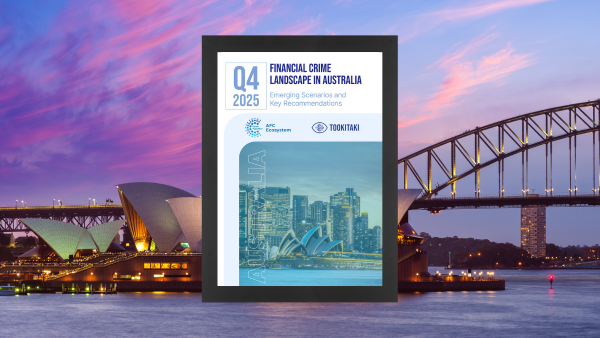
The Q4 2025 Australia Financial Crime Landscape Report highlights a clear shift from isolated fraud events to coordinated, cross-platform schemes that exploit digital speed, institutional trust, and legitimate financial products. Financial crime during the quarter increasingly relied on routine processes across payments, gambling platforms, and corporate workflows to disguise illicit value flows.
Two dominant themes shaped the quarter: online gambling–enabled laundering and persistent, adaptive account takeover (ATO) fraud. Criminal actors used low-risk betting patterns, prepaid instruments, and rapid withdrawal cycles to convert illicit funds into apparently legitimate winnings. At the same time, ATO schemes targeted payroll systems, supplier payment processes, and corporate approval hierarchies to divert and layer funds across domestic and cross-border rails.
These developments reflect a broader systemic challenge: ordinary financial activity can be structured into credible laundering pathways that closely resemble legitimate behaviour. Insights in this report are derived from scenario analysis conducted through the AFC Ecosystem, reflecting real-world observations shared by financial crime professionals across Australia’s banking and payments sector.
Q4 2025 FinCrime Landscape Report | Philippines
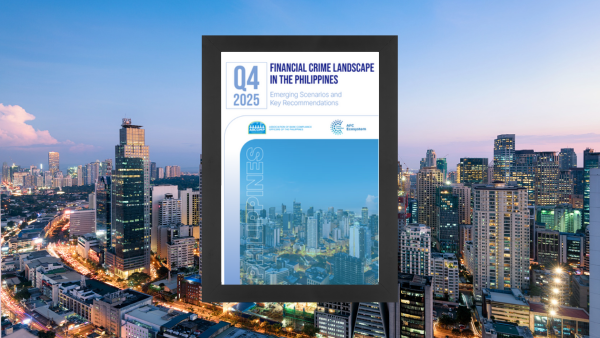
The Q4 2025 Philippines Financial Crime Landscape Report highlights a marked shift in how corruption-linked financial crime manifests across the country’s public-works and infrastructure sector.
Rather than isolated cases of tender manipulation or inflated billing, financial crime observed during the quarter reflects systemically embedded practices that begin upstream, at the budget formulation and appropriation stage, before flowing through complex procurement, subcontracting, and payment networks. These patterns increasingly resemble legitimate infrastructure activity, making detection significantly more challenging for financial institutions.
Insights in this report are derived from analysis conducted through the AFC Ecosystem in collaboration with ABCOMP, reflecting real-world observations shared by compliance professionals operating across the Philippine banking sector.
Q1 2026 FinCrime Landscape Report | ANZ
Financial crime across Australia and New Zealand is becoming harder to detect, not because it is always hidden in complex structures, but because it is often embedded within ordinary financial behaviour.
This report focuses on two key themes shaping the ANZ financial crime landscape in Q1 2026: romance scams and elder financial abuse. Both typologies exploit trust, unfold gradually, and move funds through digital banks, e-wallets, instant payments, merchant channels, and traditional banking products.
Inside the report, you will find practical scenarios, transaction-level red flags, KYC/CDD indicators, and recommendations to help financial institutions strengthen detection, protect vulnerable customers, and move beyond rule-based monitoring towards connected, pattern-based intelligence.
Download the report to explore the emerging financial crime scenarios shaping Australia and New Zealand in 2026.
Q4 2025 FinCrime Landscape Report | Australia
The Q4 2025 Australia Financial Crime Landscape Report highlights a clear shift from isolated fraud events to coordinated, cross-platform schemes that exploit digital speed, institutional trust, and legitimate financial products. Financial crime during the quarter increasingly relied on routine processes across payments, gambling platforms, and corporate workflows to disguise illicit value flows.
Two dominant themes shaped the quarter: online gambling–enabled laundering and persistent, adaptive account takeover (ATO) fraud. Criminal actors used low-risk betting patterns, prepaid instruments, and rapid withdrawal cycles to convert illicit funds into apparently legitimate winnings. At the same time, ATO schemes targeted payroll systems, supplier payment processes, and corporate approval hierarchies to divert and layer funds across domestic and cross-border rails.
These developments reflect a broader systemic challenge: ordinary financial activity can be structured into credible laundering pathways that closely resemble legitimate behaviour. Insights in this report are derived from scenario analysis conducted through the AFC Ecosystem, reflecting real-world observations shared by financial crime professionals across Australia’s banking and payments sector.
Q4 2025 FinCrime Landscape Report | Philippines
The Q4 2025 Philippines Financial Crime Landscape Report highlights a marked shift in how corruption-linked financial crime manifests across the country’s public-works and infrastructure sector.
Rather than isolated cases of tender manipulation or inflated billing, financial crime observed during the quarter reflects systemically embedded practices that begin upstream, at the budget formulation and appropriation stage, before flowing through complex procurement, subcontracting, and payment networks. These patterns increasingly resemble legitimate infrastructure activity, making detection significantly more challenging for financial institutions.
Insights in this report are derived from analysis conducted through the AFC Ecosystem in collaboration with ABCOMP, reflecting real-world observations shared by compliance professionals operating across the Philippine banking sector.