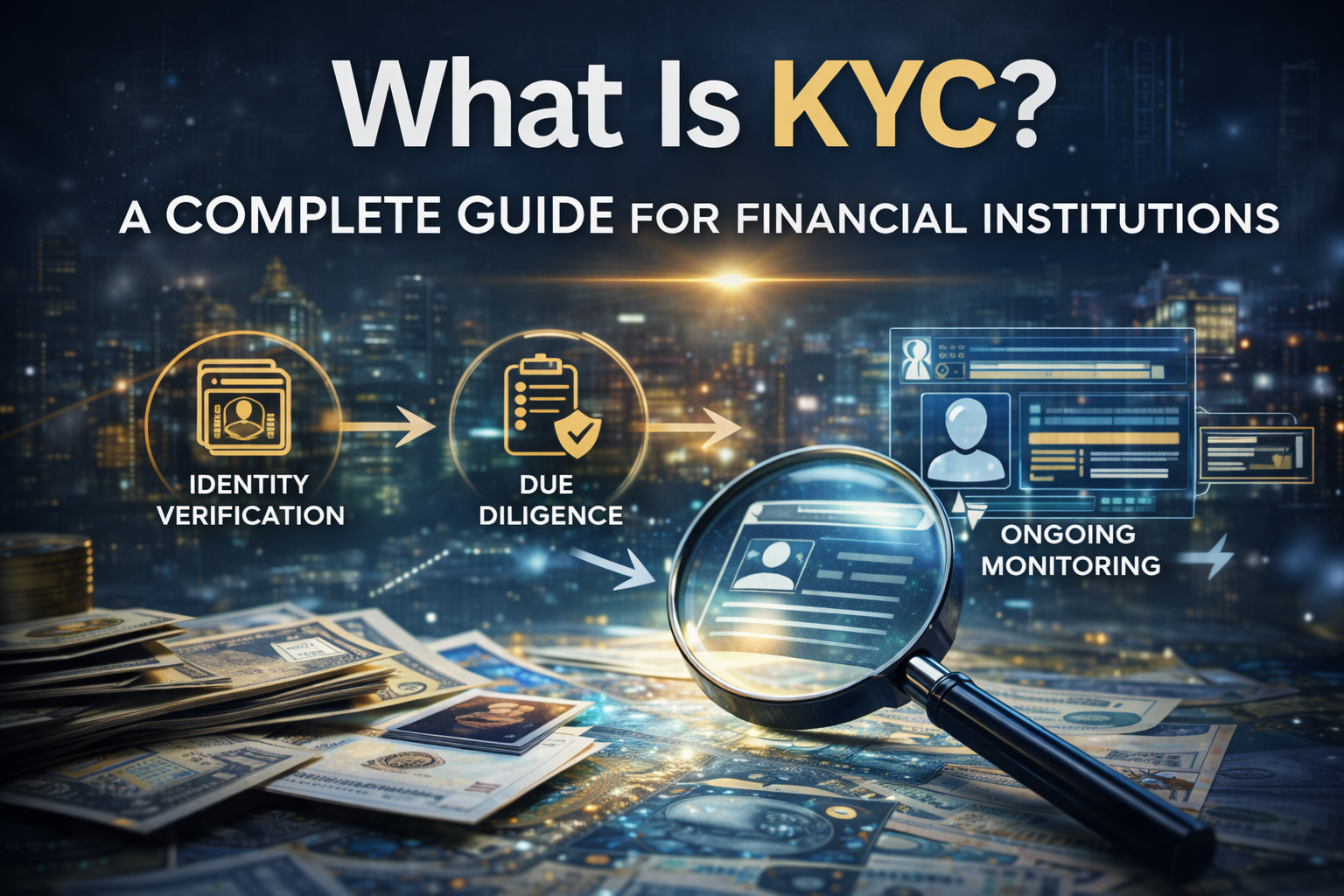
What Is KYC? A Complete Guide for Financial Institutions
KYC is often mistaken for paperwork. In reality, it is one of the first and most important risk decisions a financial institution makes.
Before a bank opens an account, before a fintech onboards a customer, and before a payments company allows funds to move through its platform, it needs to answer a basic question: who exactly is on the other side of this relationship? That is where KYC comes in.
KYC, or Know Your Customer, is the process financial institutions use to verify identity, understand customer behaviour, and assess financial crime risk at the start of a relationship and throughout it. It sits at the heart of anti-money laundering and counter-terrorist financing controls, and it plays a much bigger role than simply collecting documents.
For institutions across APAC, KYC has become both a regulatory obligation and an operational balancing act. Regulators expect strong due diligence, accurate screening, and ongoing monitoring. Customers, meanwhile, expect fast, frictionless onboarding. The challenge is no longer whether KYC matters. It is how to do it well, at scale, without creating delays, blind spots, or unnecessary manual work.
This guide explains what KYC means, how it fits into the broader AML framework, what financial institutions are expected to do, and why modern KYC is increasingly shaped by digital onboarding, continuous monitoring, and smarter risk decisioning.

What Does KYC Stand For?
KYC stands for Know Your Customer. In some contexts, it is also referred to as Know Your Client, but the idea is the same.
At its core, KYC is about establishing confidence in three things:
- that the customer is who they claim to be
- that the institution understands the nature of the relationship
- that the customer’s risk profile has been assessed properly
That may sound straightforward, but in practice KYC is doing a lot of work behind the scenes. It is not just identity verification. It is also about understanding whether the customer makes sense in context. Does their occupation align with the account they are opening? Does their source of funds appear credible? Are they linked to high-risk jurisdictions, sanctions exposure, or adverse media? Are they likely to need enhanced scrutiny from day one?
That is why KYC matters so much. It shapes what the institution knows about the customer before transactions start flowing, and it sets the foundation for how that customer will be monitored later.
Why KYC Matters More Than Ever
There was a time when KYC was treated as an onboarding task, something completed at the start of the relationship and revisited only during periodic reviews. That approach no longer holds up.
Financial crime risks have become more dynamic. Customer behaviour changes faster. Digital onboarding has accelerated volumes. Criminals use shell entities, synthetic identities, mule accounts, and layered ownership structures to make detection harder. Against that backdrop, weak KYC does not just create a documentation problem. It creates a control problem.
A poor KYC process can lead to the wrong customers being onboarded, the wrong risk ratings being assigned, and the wrong transactions being treated as normal. Once those errors enter the system, they tend to cascade. Screening becomes less effective. Monitoring becomes less targeted. Investigations become slower and more expensive.
Done well, KYC helps institutions do three things better. It improves onboarding integrity. It strengthens downstream AML controls. And it gives compliance teams a more reliable risk baseline to work from.
In other words, KYC is not just about checking identity. It is about making better risk decisions early.
The Three Core Components of KYC
KYC is usually built around three core components: identity verification, customer due diligence, and ongoing monitoring. These may be described differently across institutions, but the underlying logic stays consistent.
1. Customer Identification Programme (CIP)
This is the starting point. The institution collects and verifies the customer’s key identifying details.
For an individual, that usually includes:
- full name
- date of birth
- residential address
- nationality
- government-issued identification
For a business, the process is broader. It includes company registration details, legal structure, authorised signatories, and beneficial ownership information. This is especially important when dealing with layered entities, trusts, nominee arrangements, or cross-border corporate structures.
The purpose of CIP is simple: establish that the customer exists, that the identity is genuine, and that the institution can stand behind that conclusion if challenged by an auditor or regulator.
2. Customer Due Diligence (CDD)
Once identity is established, the next step is to assess risk.
This is where KYC moves beyond document collection and starts becoming a real compliance exercise. Institutions look at factors such as:
- occupation or business activity
- expected account usage
- source of funds
- source of wealth
- geography
- ownership structure
- PEP exposure
- sanctions exposure
- adverse media indicators
The goal is to determine what kind of customer the institution is dealing with and how much scrutiny that customer should receive.
Most institutions assign a risk rating such as low, medium, or high. High-risk customers may then move into Enhanced Due Diligence, where additional checks, supporting documents, or approvals are required before onboarding can be completed.
3. Ongoing Monitoring
This is the part many people underestimate.
KYC is not meant to freeze a customer in time. A customer who looked low-risk at onboarding may later show behaviour that changes the picture entirely. Their transaction patterns may shift. Their ownership may change. They may appear in negative media. Their exposure to high-risk geographies may increase.
That is why KYC has to continue beyond account opening.
Ongoing monitoring ensures that customer information stays current and that risk assessments continue to reflect reality. In practice, this may involve:
- periodic profile reviews
- trigger-based refreshes
- screening updates
- transaction-driven investigations
- changes to customer risk rating
This is also where KYC begins to overlap with transaction monitoring. When unusual activity is detected, the customer’s KYC profile often becomes the first place investigators look for context.
KYC vs AML: What’s the Difference?
KYC and AML are closely connected, but they are not the same thing.
AML, or Anti-Money Laundering, is the broader compliance framework. It covers the policies, controls, systems, reporting obligations, governance structures, and investigative processes institutions use to prevent, detect, and report financial crime.
KYC sits inside that larger framework.
A simple way to think about it is this:
- KYC asks: Who is this customer, and what level of risk do they represent?
- AML asks: How does the institution prevent, detect, and respond to money laundering and related financial crime risks across the business?
KYC is one of the earliest control points in the AML lifecycle. It informs how customers are screened, how they are monitored, and how suspicious activity is interpreted later.
So while people often use the terms interchangeably, they serve different purposes. You cannot build a credible AML programme without strong KYC. But KYC alone is not enough to meet AML obligations.
The KYC Process, Step by Step
The details vary by institution and jurisdiction, but the flow usually looks something like this.
Step 1: Collect customer information
The institution gathers the core identifying data needed to establish who the customer is.
For individuals, this typically includes name, date of birth, address, nationality, and occupation. For businesses, it includes legal name, registration details, ownership structure, and authorised representatives.
Step 2: Gather supporting documents
Next comes the supporting evidence.
For retail customers, this may involve an ID document and proof of address. For legal entities, it may include incorporation certificates, constitutional documents, ownership declarations, and identification for directors or beneficial owners.
Step 3: Verify identity
This is the point where the institution checks whether the documents are genuine and whether the individual or entity can be trusted as authentic.
In traditional onboarding, that verification might happen face to face. In digital onboarding, it often involves document authentication, facial matching, liveness checks, and database validation.
Step 4: Screen the customer
The customer is screened against relevant watchlists and intelligence sources.
This often includes:
- sanctions lists
- politically exposed persons lists
- adverse media sources
- internal watchlists
- law enforcement or regulatory databases where applicable
The quality of this step matters more than many institutions realise. Weak matching logic or poor-quality data can lead to both false positives and false negatives, neither of which is acceptable in a high-risk compliance setting.
Step 5: Assess risk
Once identity and screening are complete, the institution determines the customer’s risk rating.
This decision is based on the total picture, not just one field. A customer may not be sanctioned or politically exposed, but still present elevated risk because of business type, ownership complexity, expected transaction patterns, or jurisdictional exposure.
Step 6: Monitor and refresh
After onboarding, the customer enters the ongoing monitoring cycle.
That means the KYC profile should not sit untouched for years. It needs to be reviewed periodically, and refreshed when meaningful events occur. A change in ownership, a spike in transaction volume, an alert from screening, or a shift in geographic behaviour can all justify revisiting the original risk decision.
KYC Documents: What Financial Institutions Usually Require
The document set depends on the market, customer type, and institution, but the broad categories are familiar.
For individuals
Commonly requested documents include:
- passport
- national identity card
- driver’s licence
- recent proof of address such as a utility bill or bank statement
For businesses
Typical requirements include:
- certificate of incorporation
- company registration documents
- constitutional documents
- shareholder or ownership declarations
- identity documents for beneficial owners and authorised signatories
- proof of business address
What matters is not just collecting the documents, but knowing whether they are sufficient, valid, and credible in context. A technically complete file is not always a reliable one.
KYC Requirements Across APAC
While KYC rules differ across jurisdictions, the broad principles are fairly consistent. Most frameworks are aligned in some way with the FATF Recommendations, even if implementation details vary.
Australia
AUSTRAC requires reporting entities to carry out customer identification and verification, beneficial ownership checks for relevant entity types, and risk-based due diligence under the AML/CTF framework. KYC expectations continue to evolve as Australia broadens the scope of regulated services.
Singapore
MAS sets detailed expectations for customer due diligence, beneficial ownership identification, screening, and ongoing monitoring. Singapore has also been an active market for digital identity-enabled onboarding, which has made eKYC especially relevant for local institutions.
Malaysia
Bank Negara Malaysia expects reporting institutions to implement risk-based customer due diligence, including robust onboarding and ongoing monitoring measures. Malaysia has also taken visible steps to support digital onboarding through eKYC guidance.
Philippines
BSP and AMLC requirements include customer identification, verification, beneficial ownership, screening, and continuing due diligence. Digital onboarding has grown significantly, which has made KYC design even more important for banks, e-wallets, and fintechs.
New Zealand
The DIA requires reporting entities to conduct customer due diligence, identify beneficial owners where relevant, and maintain ongoing monitoring throughout the relationship. The framework remains closely aligned with FATF standards.
The point is not that every jurisdiction uses identical language. They do not. The point is that no serious financial institution in APAC can treat KYC as optional, static, or lightly operational.
What Is eKYC?
eKYC, or electronic KYC, is the digital version of the KYC process. It allows institutions to verify customer identity remotely using technology rather than relying entirely on branch visits or paper-based checks.
This may include:
- digital document capture
- document authenticity checks
- facial recognition
- liveness detection
- database validation
- API-based identity retrieval where permitted
eKYC has changed the speed and economics of onboarding across APAC. It has made it possible for digital banks, fintechs, and payments firms to onboard customers at scale without building large manual verification teams.
That said, eKYC is not simply about convenience. It also raises the bar for control design. If onboarding is fully digital, then the institution needs strong safeguards against spoofing, synthetic identities, manipulated documents, and impersonation attempts. Fast onboarding is only valuable if the underlying trust decision remains sound.
The Biggest KYC Challenges for Financial Institutions
KYC may be foundational, but it is not easy to execute well. Most institutions struggle with some combination of the following.
Manual work at scale
Manual KYC processes break down quickly when onboarding volumes rise. Review queues grow, turnaround times slip, and compliance teams end up spending too much time on repetitive tasks that technology should already be handling.
Fragmented systems
In many institutions, onboarding data, screening, and transaction monitoring live in separate systems. That makes it harder to maintain a single, consistent customer risk view.
Complex ownership structures
Beneficial ownership identification remains one of the most difficult parts of business KYC, especially when structures are layered across jurisdictions or involve nominees, trusts, or intermediaries.
Regulatory variation
Institutions operating across multiple APAC markets often need to manage different document standards, local expectations, escalation rules, and refresh requirements. That creates operational strain, especially for regional businesses trying to maintain consistency.
Poor screening performance
If screening tools are too weak, institutions risk missing sanctioned or high-risk individuals. If they are too noisy, analysts drown in false positives. Neither outcome is sustainable.
Static reviews in a dynamic risk environment
One of the biggest weaknesses in legacy KYC programmes is the assumption that annual or periodic refreshes are enough. In reality, customer risk can change well before the next review date.
How Technology Is Changing KYC
KYC is no longer just being digitised. It is being redesigned.
Modern institutions are using technology to make KYC faster, more consistent, and more responsive to changes in customer risk. That starts with digital identity verification, but it does not end there.
AI-assisted document verification can detect signs of tampering or forgery far faster than manual review alone. Biometric matching helps confirm that the person submitting the document is the legitimate holder. Smarter screening engines improve name matching across multiple languages, scripts, and transliteration variations, which is especially important in diverse regional markets.
The bigger shift, however, is in how institutions think about customer risk after onboarding.
Instead of treating KYC as a fixed event, more institutions are moving toward continuous or trigger-based KYC. In this model, risk profiles update when meaningful changes occur. A transaction anomaly, a sanctions list update, a change in ownership, or a new negative media hit can all prompt review. That approach is often described as perpetual KYC, and it reflects a much more realistic view of how risk evolves.
Another major improvement comes from integrating KYC more closely with transaction monitoring. When these controls operate in silos, investigators waste time piecing together customer context from disconnected systems. When they operate in a unified environment, institutions can make better decisions faster because customer identity, screening history, risk score, and transactional behaviour are connected.
That is where modern compliance programmes are heading: not just better onboarding, but better continuity between onboarding, screening, monitoring, and investigation.
See how Tookitaki FinCense integrates KYC risk profiling with AI-powered transaction monitoring here.
Final Thoughts
KYC may be one of the oldest concepts in financial compliance, but it is also one of the most important to get right.
At a basic level, KYC is about knowing who the customer is. At a practical level, it is about deciding whether that customer makes sense, whether the risk is acceptable, and whether the institution has enough visibility to continue the relationship with confidence.
That is why strong KYC is never just a front-end requirement. It shapes everything that comes after it. It influences screening quality, monitoring effectiveness, investigative speed, and regulatory resilience.
For financial institutions across APAC, the pressure is growing from both sides. Regulators want better controls. Customers want smoother onboarding. The institutions that handle this best will be the ones that stop treating KYC as a static form-filling exercise and start treating it as a live, risk-based discipline.
Because in the end, KYC is not only about knowing the customer. It is about knowing whether the institution can trust the relationship it is about to begin.
Experience the most intelligent AML and fraud prevention platform
Experience the most intelligent AML and fraud prevention platform
Experience the most intelligent AML and fraud prevention platform
Top AML Scenarios in ASEAN
The Role of AML Software in Compliance